
TwinPare Research · Sleep Series Article 7 of 7
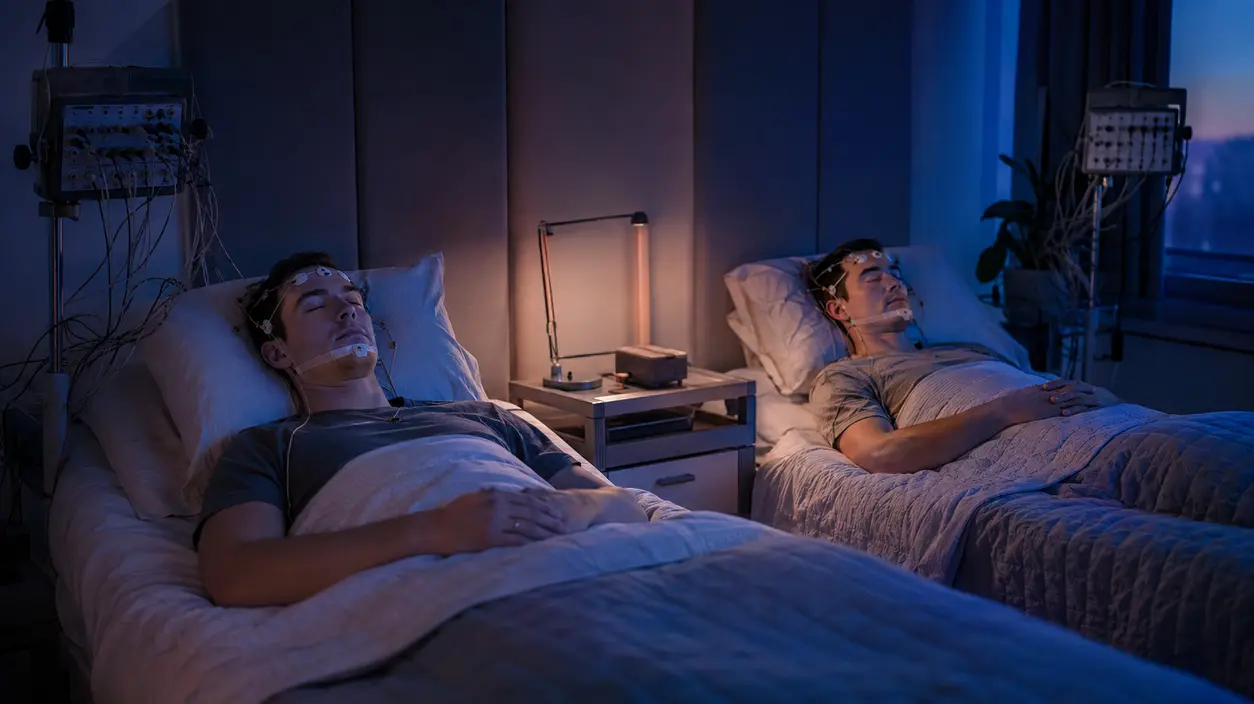
After 38 hours without sleep, the twins were finally allowed to rest. Researchers later analysed recovery sleep in 95 pairs. Their brains responded by producing deeper sleep — but not every person responded in the same way.
Quick answer
Can you catch up on lost sleep?
Key takeaways
- A recovery-sleep analysis included 57 identical and 38 fraternal same-sex twin pairs after 38 hours of monitored wakefulness.
- Recovery sleep was deeper than baseline sleep: delta power increased and an EEG-based sleep-depth measure called ORP decreased.
- The magnitude of this homeostatic response showed substantial heritability in the studied sample.
- One measure, delta power, returned to baseline by the end of the recovery night, while ORP still indicated incomplete recovery.
- One long night can restore some measures after acute sleep deprivation, but repeated sleep restriction can take longer to recover from.
- Feeling better is not proof that every cognitive, physiological, or metabolic function has fully returned to baseline.
Health and research information
This article is general educational content. It does not replace medical advice, diagnosis, or individual guidance on sleep or treatment. The experiments described here involved monitored laboratory sleep deprivation and should not be recreated personally. Do not drive or perform safety-critical work when dangerously sleepy.
Imagine that you and your twin arrive at a sleep laboratory.
For the first two nights, you can sleep normally.
Then, at eight o'clock in the morning, the real experiment begins.
You remain awake through the day.
Through the night.
Through another day.
And only at ten o'clock the following evening — after 38 continuous hours without sleep — are you finally allowed to go to bed.
At that point, most people would not need an inspirational quote, a meditation app, or a carefully optimised evening routine.
They would need a pillow.
But the scientists were interested in something much deeper than how tired the twins felt.
They wanted to know what happened inside the sleeping brain once recovery began — and whether that response was partly influenced by genetics.
- Written by the TwinPare Editorial Team
- Primary and supporting sources linked below
- Source review completed: 18 August 2026
- Research findings describe studied groups and should not be interpreted as an individual prognosis
Can you catch up on lost sleep?
Extra sleep after sleep loss can restore many functions, particularly after a single episode of acute sleep deprivation. The brain also compensates by making recovery sleep deeper. But recovery is not a simple hour-for-hour repayment: different biological and cognitive functions recover at different speeds, and repeated short sleep may leave deficits after several long recovery nights.
Twin research further suggests that the strength of the brain's homeostatic response to sleep deprivation is partly heritable at the population level.
This is the sequel to the 38-hour twin experiment
In Article 2 of this series, we examined what happened while 100 twin pairs were kept awake for 38 hours.
Every two hours, the participants completed a ten-minute Psychomotor Vigilance Test. Some accumulated attention lapses rapidly. Others remained surprisingly resilient for longer.
Identical twins resembled one another more strongly than fraternal twins in the rate at which those performance deficits accumulated. The researchers concluded that vulnerability to sleep deprivation had a substantial heritable component in that protocol.
But the experiment did not end when the twins finally closed their eyes.
The later recovery analysis came from the same research project. Two hundred people — 100 twin pairs — completed the laboratory protocol. For the recovery-sleep paper, the researchers analysed 95 pairs after excluding four pairs because of technical problems and one pair because one twin carried a rare sleep-related genetic variant that was studied separately.
The final recovery sample therefore included:
Instead of asking who lost attention fastest, the researchers now asked:
How does the sleeping brain respond after extreme sleep loss — and do identical twins respond more similarly than fraternal twins?
- 57 monozygotic, or identical, twin pairs
- 38 dizygotic, or fraternal, same-sex twin pairs
- 190 people in total
Four and a half days inside the sleep laboratory
Before entering the laboratory, participants were asked to maintain a regular sleep schedule. They recorded sleep in diaries and wore wrist activity monitors.
The laboratory protocol then lasted four and a half consecutive days.
Researchers recorded sleep using polysomnography during the adaptation, baseline, and recovery nights. The setup included EEG leads that measured electrical activity from the brain, eye-movement sensors, and chin-muscle recordings.
The twins were allowed to sleep until they woke naturally during the recovery period.
No caffeine was permitted to rescue them from the protocol.
- Day 1 was an adaptation day.
- Day 2 provided baseline sleep.
- At 08:00 on Day 3, the 38-hour period of continuous wakefulness began.
- At 22:00 on Day 4, the participants were finally given an uninterrupted recovery-sleep opportunity.
The brain did not simply ask for more sleep — it changed the sleep itself
After the 38 hours awake, recovery sleep was measurably deeper than baseline sleep.
The researchers studied this with two EEG-derived measures.
Delta power
Delta activity refers to slow electrical activity that becomes prominent during deep non-REM sleep. It has long been used as a marker of homeostatic sleep pressure: the longer someone has been awake, the stronger the early-night delta response tends to become.
In the twins, delta power was higher during recovery sleep than during baseline sleep, particularly earlier in the sleep period.
Odds Ratio Product, or ORP
ORP is a continuous EEG-based measure of sleep depth and wake propensity. Lower ORP values indicate deeper sleep and a lower tendency to wake.
ORP was lower throughout the recovery night than during the baseline night.
Together, the two measures showed that the brain was not merely adding time to a sleep account. It was changing the intensity and depth of sleep in response to the extended period awake.
That process is called sleep homeostasis.
In simple terms, sleep pressure rises while we remain awake and falls while we sleep. Recovery sleep is one way the brain responds when that pressure has become unusually high.
One recovery night — two different answers
One of the most revealing results appeared near the end of the recovery night.
Delta power had returned to its baseline level.
ORP had not.
It still indicated deeper sleep and incomplete recovery relative to baseline.
That does not mean one measure was correct and the other was wrong. They capture overlapping but different properties of the sleeping brain.
It also gives us an important warning about the phrase “fully recovered.”
Recovery depends on what is being measured.
A person may feel less sleepy.
Reaction time may improve.
One EEG marker may return to baseline.
Another may not.
Metabolic, emotional, and cognitive functions may follow still other timelines.
There is no single biological switch that moves from “sleep deprived” to “fully repaired” at the same moment everywhere in the body.
The recovery response was partly heritable
This is where the twin design became central.
The researchers compared how similar the recovery responses were within identical and fraternal twin pairs. Because identical twins share essentially the same DNA sequence while fraternal twins share, on average, about half of the genetic variants that differ between people, greater similarity within identical pairs can indicate a genetic contribution to variation in the trait.
Using the classical twin approach, the researchers estimated broad-sense heritability at approximately:
Using complementary mixed-effect models, the estimated proportions of variation attributed to additive genetic transmission were approximately:
The precise estimates therefore depended on the statistical model, but both approaches supported the same broader conclusion:
People differ in how strongly their sleep deepens after sleep deprivation, and genetic differences appear to explain part of that variation in this population.
- 43% for the ORP response
- 73% for the delta-power response
- 50% for ORP
- 57% for delta power
What heritability does — and does not — mean
It would be tempting to write:
“Seventy-three percent of your ability to recover from sleep loss is genetic.”
That would be wrong.
Heritability is a population-level statistic. It describes how much of the observed variation between people, in a particular population and environment, can statistically be linked to genetic differences.
It does not divide one person's recovery into a genetic percentage and an environmental percentage.
It does not tell you whether you personally can function safely after four hours of sleep.
And it certainly does not make an all-nighter harmless for people whose genes seem favourable.
The study examined the homeostatic response in specific EEG measures. It did not calculate a universal “recovery ability,” and it did not test every health consequence of sleep loss.
Can one long night repair one sleepless night?
Sometimes — for some outcomes — recovery can be surprisingly fast.
In a separate non-twin study, 22 participants underwent 36 hours of sleep deprivation and then received one ten-hour recovery-sleep opportunity. Objective vigilance and subjective ratings returned to baseline after that recovery night. Greater delta and theta power during deep sleep was associated with better restoration of vigilance.
That is encouraging.
But it does not prove that every biological function had recovered, and the study was small.
A larger experiment involving 83 adults makes the distinction clearer. Participants received either five nights with only four hours in bed or 36 hours of total sleep deprivation. Both groups then received four recovery nights with up to twelve hours in bed.
Most measured functions improved substantially after the first recovery night.
But not everything followed the same curve:
The surprising lesson is that a single episode of total sleep deprivation may be recovered from more quickly on some measures than several consecutive nights of restricted sleep.
One dramatic bad night and one working week of too little sleep are not biologically identical problems.
- After repeated sleep restriction, lapses and response speed on the vigilance test did not completely recover.
- After total sleep deprivation, self-reported vigor remained below baseline.
- Those residual differences were still present after four long recovery nights.
Sleep debt is useful — but it is not a bank statement
The phrase “sleep debt” is useful because it communicates that lost sleep creates pressure for recovery.
But the banking metaphor has limits.
If you lose four hours of sleep, the body does not necessarily demand exactly four additional hours the following night.
It can compensate by:
At the same time, some deficits may outlast the period in which you feel obviously exhausted.
The repayment is therefore not a simple transfer of hours.
It is a changing biological process.
- extending sleep time
- increasing sleep efficiency
- increasing the intensity of parts of sleep
- changing the distribution of sleep stages
What about sleeping late at the weekend?
Weekend catch-up sleep is neither useless nor a magic shield.
In a controlled study of 36 healthy young adults, one group received five-hour sleep opportunities during a simulated workweek, could then sleep freely during a recovery weekend, and returned to insufficient sleep afterward. The extra weekend sleep did not prevent weight gain or the reduction in insulin sensitivity associated with the repeated pattern of insufficient sleep.
But another small crossover study of 19 men with habitual workweek sleep restriction found that three nights with ten hours in bed improved insulin sensitivity compared with continuing to receive six hours in bed.
Those findings are not necessarily contradictory.
The studies tested different people, schedules, recovery opportunities, and outcomes. One examined a restrict–recover–restrict cycle; the other compared three nights of sleep extension with continued restriction.
The responsible conclusion is not:
“Weekend sleep never works.”
It is:
Extra sleep can help, but a short recovery window should not be treated as permission to repeat inadequate sleep every week.
The twin with the rare short-sleep variant
Remember the fifth twin pair excluded from the main recovery analysis?
That pair produced a remarkable scientific clue of its own.
Researchers identified a rare Y362H variant in the BHLHE41 gene in one member of a fraternal twin pair. The carrier slept less, required less recovery sleep, and had fewer performance lapses during sleep deprivation than the co-twin. Both twins had almost identical amounts of non-REM sleep.
It is a fascinating comparison.
It is also one twin pair.
The result cannot be generalised to the wider population, and it does not mean that people who habitually sleep too little are “natural short sleepers.” Rare biological exceptions should not become everyday sleep advice.
What the twin study does not prove
The main twin experiment is unusually strong for investigating heritable differences in the EEG response to sleep deprivation. It still has important limits.
- The participants were relatively young, healthy adults, which limits generalisation to older people, children, or people with sleep and medical disorders.
- Heritability estimates apply to variation in the studied population and protocol, not to every population or individual.
- ORP requires specialised EEG analysis and is not equivalent to the “deep sleep” estimate shown by a consumer wearable.
- At the time of publication, ORP analysis depended on a commercially available automated system developed by one of the authors, which the paper identified as a potential limitation for replication.
- The experiment studied acute, monitored sleep deprivation. It does not reproduce years of shift work, insomnia, sleep apnoea, caregiving, or lifestyle-driven short sleep.
- Deeper recovery sleep is evidence of a homeostatic response. It is not proof that every effect of sleep loss has been repaired.
The TwinPare perspective
Together, Articles 2 and 7 tell a rare two-part story.
The first part asks what happens while the twins are forced to remain awake.
The second asks what happens when they finally get to sleep.
In both phases, people differed substantially.
Some accumulated attention failures faster than others.
Some produced a stronger homeostatic recovery response than others.
And in both cases, identical twins resembled one another more than fraternal twins.
That does not make sleep destiny.
It makes sleep personal.
The value of twin research is not that it gives every person a genetic excuse or a perfect prescription. It shows why universal statements such as “one night is always enough” or “nobody can recover lost sleep” are too simple.
Human recovery varies.
The type of sleep loss matters.
The outcome being measured matters.
And time matters.
From research to your own data
TwinPare Health & Fitness is being developed to help people view sleep, activity, training, and recovery trends over time.
That can support useful questions after an unavoidable short night:
These observations cannot reveal whether genetics caused a difference.
They also cannot reproduce laboratory polysomnography, measure ORP, or determine whether the brain is clinically “recovered.” Consumer wearables estimate sleep from limited signals and should not be presented as EEG laboratories on the wrist.
But longitudinal data can still do something valuable.
It can replace a vague memory — “I think I bounced back quickly” — with a clearer personal record.
Observe. Compare. Look for repeated patterns. Stay curious.
And never deliberately deprive yourself of sleep to create more interesting data.
Explore TwinPare Health & Fitness
- Did your sleep duration increase during the following nights?
- Did your sleep timing move substantially?
- How long did subjective energy or training readiness appear lower?
- Did your normal pattern return after one night or several?
- If you compare voluntarily with a twin, sibling, partner, or friend, do your visible recovery patterns differ?
TwinPare Research — the takeaway
Yes, extra sleep after sleep loss helps.
After 38 hours awake, recovery sleep in 95 twin pairs became deeper, and the strength of that response showed a substantial heritable component. But one EEG measure returned to baseline while another still indicated incomplete recovery at the end of the night.
Other experiments show the same broader pattern: one long night can restore some functions after acute sleep deprivation, while repeated short sleep may leave residual deficits after several recovery nights.
Lost sleep is therefore not repaid like money.
The brain changes both the duration and intensity of sleep, different systems recover on different schedules, and genetics appears to contribute to why people respond differently.
The safest conclusion is also the least glamorous:
Use additional sleep to recover when sleep loss happens — but do not build your normal routine around needing to be rescued every weekend.
Source notes
The primary and supporting studies below were reviewed for this article. Their findings are presented within the limits of the measured outcomes and study designs.
- Goldschmied JR, Kuna ST, Maislin G, Tanayapong P, Pack AI, Younes M. “The sleep homeostatic response to sleep deprivation in humans is heritable.” Sleep. 2023;46(3):zsac314. DOI · PubMed · Full text
- Evidence type: MZ/DZ twin experiment; recovery sleep after 38 hours of monitored sleep deprivation.
- Main limitation: Measures heritability of EEG-derived homeostatic responses in relatively young, healthy adults; it does not measure a universal ability to recover.
- Kuna ST, Maislin G, Pack FM, et al. “Heritability of performance deficit accumulation during acute sleep deprivation in twins.” Sleep. 2012;35(9):1223–1233. DOI · PubMed
- Evidence type: MZ/DZ twin experiment; repeated vigilance testing during 38 hours of continuous wakefulness.
- Main limitation: Heritability estimates relate to performance-deficit accumulation on the studied vigilance protocol.
- Pellegrino R, Kavakli IH, Goel N, et al. “A novel BHLHE41 variant is associated with short sleep and resistance to sleep deprivation in humans.” Sleep. 2014;37(8):1327–1336. DOI · PubMed
- Evidence type: Genetic sequencing and phenotyping, including one discordant fraternal twin pair.
- Main limitation: The striking co-twin comparison is based on a single pair and is not population-level evidence.
- Hao C, Li M, Ning Q, Ma N. “One night of 10-h sleep restores vigilance after total sleep deprivation: the role of delta and theta power during recovery sleep.” Sleep and Biological Rhythms. 2023;21(2):165–173. Published online 2022. DOI · PubMed · Full text
- Evidence type: Small experimental recovery-sleep study with polysomnography and vigilance testing.
- Main limitation: Twenty-two participants and selected outcomes; baseline performance on those outcomes does not prove whole-body recovery.
- Yamazaki EM, Antler CA, Lasek CR, Goel N. “Residual, differential neurobehavioral deficits linger after multiple recovery nights following chronic sleep restriction or acute total sleep deprivation.” Sleep. 2021;44(4):zsaa224. DOI · PubMed · Full text
- Evidence type: Randomised laboratory comparison of chronic sleep restriction and acute total sleep deprivation followed by four recovery nights.
- Main limitation: Recovery differed by outcome; the findings do not define an exact recovery duration for every person.
- Depner CM, Melanson EL, Eckel RH, et al. “Ad libitum Weekend Recovery Sleep Fails to Prevent Metabolic Dysregulation during a Repeating Pattern of Insufficient Sleep and Weekend Recovery Sleep.” Current Biology. 2019;29(6):957–967.e4. DOI · PubMed
- Evidence type: Controlled laboratory study of sustained restriction and a restrict–recover–restrict weekend pattern.
- Main limitation: Thirty-six healthy young adults and a short experimental protocol; findings should remain tied to the studied metabolic outcomes.
- Killick R, Hoyos CM, Melehan KL, et al. “Metabolic and hormonal effects of ‘catch-up’ sleep in men with chronic, repetitive, lifestyle-driven sleep restriction.” Clinical Endocrinology. 2015;83(4):498–507. DOI · PubMed
- Evidence type: Small randomised crossover study comparing three nights of sleep extension with continued restriction.
- Main limitation: Nineteen men with a specific habitual sleep pattern; the result does not establish a universal weekend prescription.
Continue the Sleep Series
Companion article: 38 Hours Without Sleep: Why Some Brains Handle Sleep Loss Better Than Others
Previous article: Why Does the Baby Keep Waking Up? A Swedish Twin Study Offers a Surprising Clue
Source notes
The sources have been verified and editorially reviewed for this article. The limitations below show which level of conclusion the sources support.
- [source-1] DOI Linked publication or source record. doi.org, 2023. Evidence type: Primary or supporting source listed in the article review Limitation: Read the source together with the article’s visible limitations; the link does not support every broader interpretation. Open source
- [source-2] PubMed Linked publication or source record. pubmed.ncbi.nlm.nih.gov, 2023. Evidence type: Primary or supporting source listed in the article review Limitation: Read the source together with the article’s visible limitations; the link does not support every broader interpretation. Open source
- [source-3] Full text Linked publication or source record. academic.oup.com, 2023. Evidence type: Primary or supporting source listed in the article review Limitation: Read the source together with the article’s visible limitations; the link does not support every broader interpretation. Open source
- [source-4] DOI Linked publication or source record. doi.org, 2074. Evidence type: Primary or supporting source listed in the article review Limitation: Read the source together with the article’s visible limitations; the link does not support every broader interpretation. Open source
- [source-5] PubMed Linked publication or source record. pubmed.ncbi.nlm.nih.gov, 2074. Evidence type: Primary or supporting source listed in the article review Limitation: Read the source together with the article’s visible limitations; the link does not support every broader interpretation. Open source
- [source-6] DOI Linked publication or source record. doi.org, 2014. Evidence type: Primary or supporting source listed in the article review Limitation: Read the source together with the article’s visible limitations; the link does not support every broader interpretation. Open source
- [source-7] PubMed Linked publication or source record. pubmed.ncbi.nlm.nih.gov, 2014. Evidence type: Primary or supporting source listed in the article review Limitation: Read the source together with the article’s visible limitations; the link does not support every broader interpretation. Open source
- [source-8] DOI Linked publication or source record. doi.org, 2022. Evidence type: Primary or supporting source listed in the article review Limitation: Read the source together with the article’s visible limitations; the link does not support every broader interpretation. Open source
- [source-9] PubMed Linked publication or source record. pubmed.ncbi.nlm.nih.gov, 2022. Evidence type: Primary or supporting source listed in the article review Limitation: Read the source together with the article’s visible limitations; the link does not support every broader interpretation. Open source
- [source-10] Full text Linked publication or source record. pmc.ncbi.nlm.nih.gov, 2022. Evidence type: Primary or supporting source listed in the article review Limitation: Read the source together with the article’s visible limitations; the link does not support every broader interpretation. Open source
- [source-11] DOI Linked publication or source record. doi.org, 2021. Evidence type: Primary or supporting source listed in the article review Limitation: Read the source together with the article’s visible limitations; the link does not support every broader interpretation. Open source
- [source-12] PubMed Linked publication or source record. pubmed.ncbi.nlm.nih.gov, 2021. Evidence type: Primary or supporting source listed in the article review Limitation: Read the source together with the article’s visible limitations; the link does not support every broader interpretation. Open source
- [source-13] Full text Linked publication or source record. academic.oup.com, 2021. Evidence type: Primary or supporting source listed in the article review Limitation: Read the source together with the article’s visible limitations; the link does not support every broader interpretation. Open source
- [source-14] DOI Linked publication or source record. doi.org, 2019. Evidence type: Primary or supporting source listed in the article review Limitation: Read the source together with the article’s visible limitations; the link does not support every broader interpretation. Open source
- [source-15] PubMed Linked publication or source record. pubmed.ncbi.nlm.nih.gov, 2019. Evidence type: Primary or supporting source listed in the article review Limitation: Read the source together with the article’s visible limitations; the link does not support every broader interpretation. Open source
- [source-16] DOI Linked publication or source record. doi.org, 2015. Evidence type: Primary or supporting source listed in the article review Limitation: Read the source together with the article’s visible limitations; the link does not support every broader interpretation. Open source
- [source-17] PubMed Linked publication or source record. pubmed.ncbi.nlm.nih.gov, 2015. Evidence type: Primary or supporting source listed in the article review Limitation: Read the source together with the article’s visible limitations; the link does not support every broader interpretation. Open source
- [source-18] 38 Hours Without Sleep: Why Some Brains Handle Sleep Loss Better Than Others Linked publication or source record. twinpare.com, 2026. Evidence type: Primary or supporting source listed in the article review Limitation: Read the source together with the article’s visible limitations; the link does not support every broader interpretation. Open source
Editorial source review
This section shows how the article's key factual claims are linked to the source.
Phrasings that require caution
- Sleep recovery is not a simple hour-for-hour balance.
- The laboratory sleep-deprivation protocol should not be recreated personally.
- Feeling better does not prove that every function has recovered.