
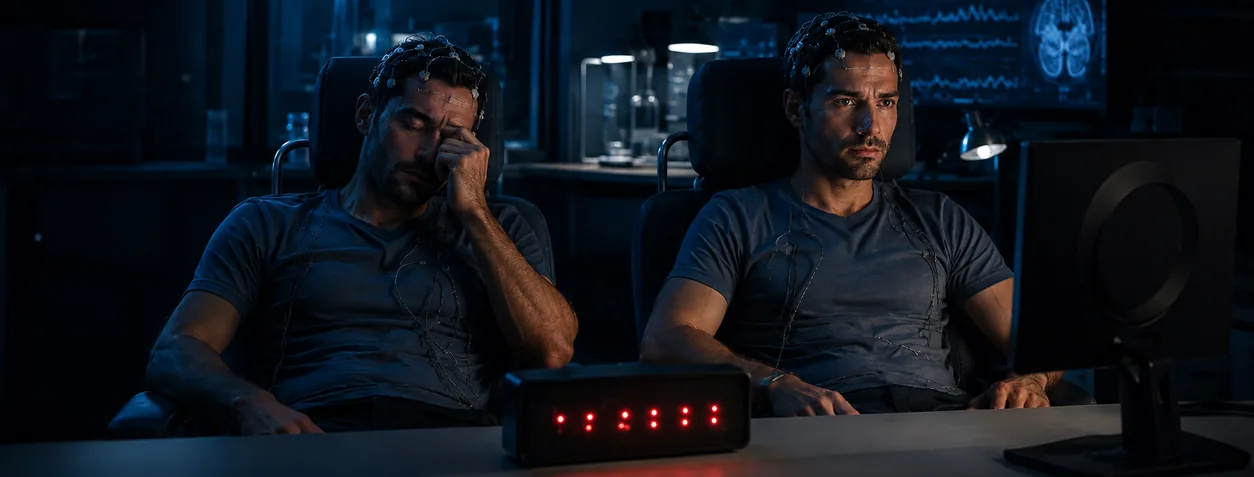
Two people stay awake all night. By the next morning, one is slow, distracted and barely functioning. The other still seems surprisingly sharp. Why?
In 2012, researchers published an unusual twin experiment that offered a fascinating clue.
They recruited 100 twin pairs:
59 pairs of identical twins and 41 pairs of fraternal twins.
Then they did something most of us would probably prefer not to volunteer for.
They kept them awake for 38 hours of continuous, monitored sleep deprivation.
Quick answer
Do all brains respond to sleep loss the same way?
No. In one monitored twin experiment, people accumulated vigilance lapses at different rates, and identical twins resembled each other more than fraternal twins.
Key takeaways
- In a 38-hour monitored sleep-deprivation protocol, identical twins resembled each other more than fraternal twins in performance-deficit accumulation.
- Do not write that 83% of an individual person’s ability to handle sleep deprivation is genetic.
- The article is general research information, not medical advice or an individual prediction.
A test every two hours
Throughout the experiment, participants repeatedly completed a ten-minute Psychomotor Vigilance Test, or PVT.
The test is simple.
When a visual signal appears, you respond as quickly as possible.
But when people become sleep deprived, something very interesting happens.
Responses slow down.
And increasingly, people experience what researchers call lapses — moments when attention fails and the response comes far too late.
During the 38-hour protocol, participants performed the PVT every two hours.
As expected, performance deteriorated as sleep deprivation continued.
But it did not deteriorate at the same rate in everyone.
Some participants accumulated attention lapses rapidly.
Others were remarkably more resistant.
The crucial question was:
Did twins resemble each other in how quickly they deteriorated?
The answer was particularly striking for identical twins.
A strong genetic signal — but not one simple number
Identical twins showed considerably more similarity in their rate of performance decline than fraternal twins.
Depending on the statistical method used, the researchers obtained different estimates of the genetic contribution.
Using a classical twin approach, the broad-sense heritability estimate was approximately:
83.4%.
An analysis-of-variance approach produced an estimate of approximately:
71.5%.
And a multilevel modelling approach attributed approximately:
51.1% of twin variance
to combined additive and dominance genetic effects.
All three methods pointed in the same general direction:
genetic differences appeared to explain a substantial part of why some people accumulated vigilance deficits faster than others during acute sleep deprivation.
But those numbers need to be interpreted carefully.
“83% of your ability to handle sleep deprivation is genetic”?
No.
That would be an excellent social-media headline.
It would also be misleading.
The study did not show that 83% of your personal ability to survive a sleepless night is determined by your genes.
Heritability describes variation between people in a studied population under particular conditions.
And the study measured something very specific:
the rate at which performance deficits accumulated on a sustained-attention test during acute total sleep deprivation.
It did not measure every consequence of sleep loss.
That distinction matters.
Being less impaired does not mean being immune
Imagine two people after a terrible night of sleep.
One says:
“I can barely think.”
The other says:
“I actually feel fine.”
It is tempting to conclude that the second person simply “needs less sleep.”
But that is not what this experiment demonstrates.
Someone may remain relatively good at a reaction-time task while other systems are being affected.
Sleep interacts with cognition, metabolism, immune function, hormonal regulation, mood and many other physiological processes.
A ten-minute vigilance test does not capture all of them.
So if someone says:
“Five hours is enough for me. I have good sleep genes.”
this study does not prove their case.
What it does show is more subtle — and perhaps more interesting.
The same amount of sleep deprivation can produce very different measurable responses in different people.
And some of that variation appears to be biologically influenced.
The TwinPare perspective
This is one of the reasons twin research is so useful.
It challenges a common assumption in health and fitness:
that the same input should always create the same response.
Same workout.
Same diet.
Same sleep duration.
Same recovery strategy.
Same result.
Biology does not work that neatly.
Sleep deprivation is still sleep deprivation.
But people can respond differently to it.
That changes the question.
Instead of asking:
“How well should I function after seven hours of sleep?”
a more useful question may be:
“What tends to happen to me when my sleep changes?”
Do you notice different activity patterns after shorter nights?
Does training feel different?
Does your resting heart rate move?
Does your recovery trend change?
Are there patterns that repeatedly appear after several nights rather than just one?
One isolated day tells us very little.
Repeated patterns across weeks and months are much more interesting.
And even then, correlation is not causation.
From research to your own data
TwinPare Health & Fitness is being developed around a simple idea:
individual variation is information.
Research can show us how groups of people tend to respond.
Longitudinal personal data can help you explore how your own measurements tend to move together.
That does not turn a consumer health app into a laboratory.
And it does not mean every visible pattern has a meaningful biological cause.
But it can make your health history easier to explore.
Observe what changes. Compare over time. Look for repeatable patterns.
Do NOT encourage users to deliberately deprive themselves of sleep.
The product bridge must concern naturally occurring lower-sleep nights already present in someone's history.
TwinPare Research — the takeaway
People differ substantially in how rapidly sustained attention deteriorates during acute sleep deprivation.
In a controlled study of 100 twin pairs exposed to 38 hours without sleep, identical twins resembled each other more strongly than fraternal twins in the rate at which performance deficits accumulated.
The results suggest a strong genetic contribution to this particular response.
They do not mean that some people are genetically immune to inadequate sleep.
Source notes
The source has been verified and editorially reviewed for this article. The limitations below show which level of conclusion the sources support.
- [kuna-2012] Heritability of Performance Deficit Accumulation During Acute Sleep Deprivation in Twins. S. T. Kuna; G. Maislin; F. M. Pack; B. Staley; R. Hachadoorian; E. F. Coccaro; A. I. Pack. Sleep, 2012. Evidence type: Twin experiment in 100 twin pairs during 38 hours of monitored sleep deprivation using repeated psychomotor vigilance testing Limitation: The heritability estimates describe variation in performance-deficit accumulation in the studied protocol. They do not mean an individual person is 83% genetically protected or vulnerable, and they do not make sleep deprivation safe. PubMed PMC DOI
Editorial source review
This section shows how the article's key factual claims are linked to the source.
Phrasings that require caution
- Do not write that 83% of an individual person’s ability to handle sleep deprivation is genetic.
- Do not imply sleep deprivation is safe or worth testing personally.
- Keep the estimates tied to the studied vigilance protocol.
| ID | Claim | Source support | Caution |
|---|---|---|---|
| S2 | In a 38-hour monitored sleep-deprivation protocol, identical twins resembled each other more than fraternal twins in performance-deficit accumulation. | 2012 | Do not write that 83% of an individual person’s ability to handle sleep deprivation is genetic. |