
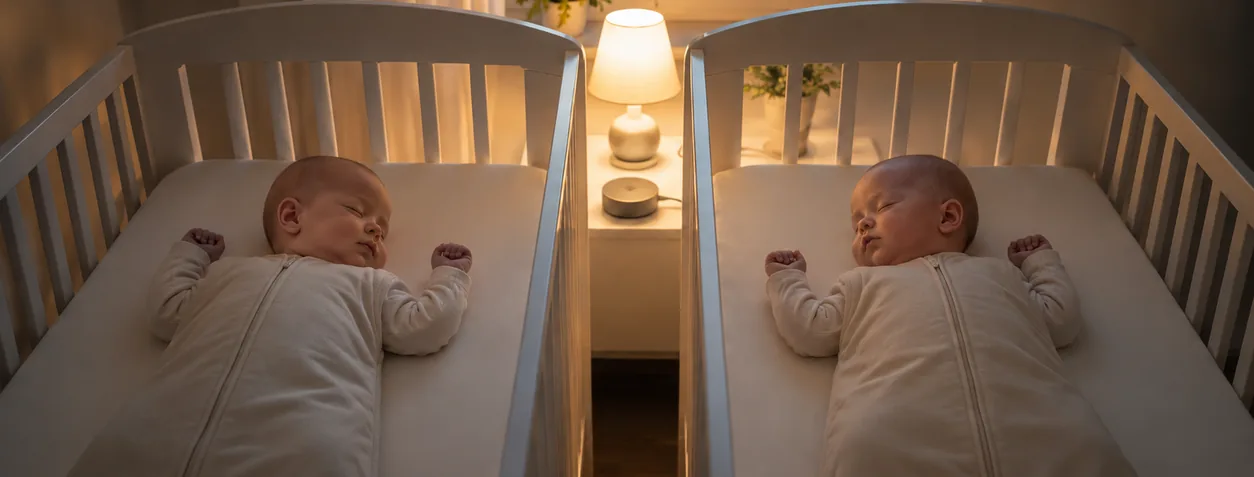
Two babies. The same age. The same family. Very similar genes. And yet their sleep, crying and ability to settle can still develop differently.
For parents of young babies, sleep can quickly become an emotional subject.
The internet offers endless explanations.
Your routine is wrong.
The baby is “just like that.”
You must sleep-train.
You must never sleep-train.
You are responding too quickly.
You are not responding quickly enough.
Reality is considerably more complicated.
A large Swedish twin study gives us an unusually useful perspective.
Quick answer
Are infant sleep differences all about parenting?
No. A Swedish twin study suggests that both shared environment and genetic influences can matter, and that their relative importance may change within early development.
Key takeaways
- A Swedish infant twin study found changing genetic and environmental contributions to night waking, settling and crying across early infancy.
- Do not interpret shared environment as parental blame.
- The article is general research information, not medical advice or an individual prediction.
Almost one thousand Swedish twins
Researchers studied 998 twins.
The children were assessed at approximately two and five months of age.
Researchers examined several behaviours, including:
night-time awakenings,
the ability to settle
and crying duration.
Using the classical twin design, they estimated how much of the variation in these behaviours could statistically be attributed to genetic influences, shared environmental influences and non-shared environmental influences.
The results are a beautiful example of why simple explanations often fail.
Night waking: shared environment mattered a lot
For the number of awakenings per night, shared environmental influences accounted for a large proportion of variation at both two and five months.
Depending on age and analysis, the estimates were approximately:
61–90%.
That does not mean:
“Parents cause 61–90% of night waking.”
Shared environment is a statistical category.
It represents influences that tend to make twins in the same family more similar.
Those influences can include many factors.
But the result does suggest that, in this study, early night-waking behaviour was strongly associated with environmental influences shared by the twins.
A few months later, the picture changed
When researchers examined the babies' ability to settle, they found something different.
At two months, shared environmental influences were prominent.
At five months, genetic factors were much more evident.
For different measures of settling ability at five months, genetic influences accounted for approximately:
51–67% of the variation.
That is fascinating.
Over just a few months of early development, the relative contribution of genetic and environmental influences appeared to shift.
It is a reminder that heritability is not a permanent number stamped onto a human being at birth.
Development matters.
Environment matters.
Age matters.
What about crying?
Crying duration also showed substantial genetic influence.
Depending on the measure and age, estimated genetic contributions ranged approximately from:
29–70%.
Again, this does not mean that one particular baby's crying is “70% genetic.”
Heritability describes variation across a studied population.
But the result does challenge an idea that can become very painful for parents:
that every difference in an infant's behaviour must be the consequence of something the parent has done.
Babies are not identical inputs waiting for the correct method
Modern parenting culture can sometimes make childhood look like an optimization problem.
If the baby sleeps well:
good routine.
If the baby sleeps badly:
bad routine.
If the baby settles quickly:
good technique.
If the baby does not:
find a new method.
Twin research shows why reality is more complicated.
Babies arrive with biological differences.
Their environment matters.
Their biology matters.
And the relative importance of those influences can change rapidly during development.
That does not mean routines are irrelevant.
It means the same routine does not necessarily produce the same result in every child.
Even twins can remind us of that.
The TwinPare perspective
This is perhaps one of the purest illustrations of the entire TwinPare idea:
human beings develop through a continuous interaction between biology and environment.
Twin studies give researchers a remarkable tool for studying that interaction.
But the lesson extends far beyond twins.
It encourages us to become less categorical.
Less:
“This works for everyone.”
And more:
“This often works — but individuals may still respond differently.”
That principle follows us throughout life.
Sleep.
Activity.
Training.
Recovery.
Nutrition.
Stress.
Our biological starting points matter.
So do our environments and behaviours.
From infant research to personalised health
This particular study is not a Health & Fitness app study.
And we should not pretend that it is.
Its value for TwinPare is broader.
It demonstrates why individual variation deserves to be taken seriously from the very beginning of life.
TwinPare Health & Fitness applies a related principle to adult health:
start with established research,
observe data over time,
look for individual patterns,
and avoid claiming more than the data can show.
Personalised health does not have to mean pseudoscience.
Used carefully, personal data can instead make us more scientifically curious about the one body we will observe for our entire lives:
our own.
TwinPare Research — the takeaway
In a longitudinal study of 998 Swedish twins assessed at two and five months of age, shared environmental influences accounted for much of the variation in night-time waking, while genetic influences became more prominent for some settling behaviours by five months.
Crying duration also showed substantial genetic influence.
The central lesson is not that infant behaviour is “genetic” or “environmental.”
It is that both matter — and their relative influence can change rapidly during early development.
Source notes
The source has been verified and editorially reviewed for this article. The limitations below show which level of conclusion the sources support.
- [viktorsson-2026] Genetic and environmental influences on sleep quality, ability to settle, and crying duration in 2- and 5-month-old infants: A longitudinal twin study. C. Viktorsson; A. Yahia; M. J. Taylor; A. Ronald; K. Tammimies; T. Falck-Ytter. JCPP Advances, 2026. Evidence type: Longitudinal Swedish twin study of 998 infants assessed at approximately two and five months of age Limitation: Shared environment must not be interpreted as parental blame. Heritability estimates are population-level, and infant research should not be turned into a forced Health & Fitness app conversion message. Primary source DOI
Editorial source review
This section shows how the article's key factual claims are linked to the source.
Phrasings that require caution
- Do not interpret shared environment as parental blame.
- Heritability is population-level.
- Do not turn infant research into a forced Health & Fitness app sales message.
| ID | Claim | Source support | Caution |
|---|---|---|---|
| S6 | A Swedish infant twin study found changing genetic and environmental contributions to night waking, settling and crying across early infancy. | 2026 | Do not interpret shared environment as parental blame. |