
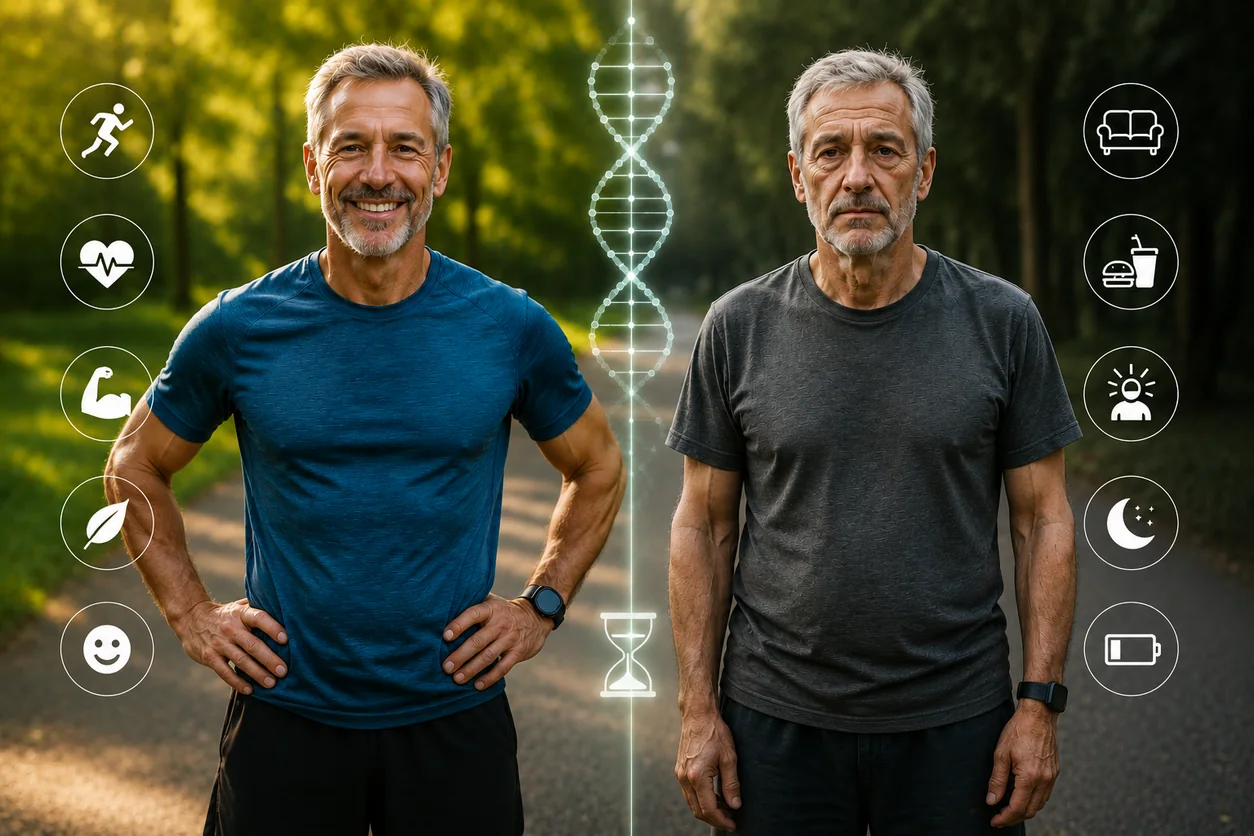
Can Identical Twins Have Different Biological Ages?
Epigenetic clocks are partly heritable — yet person-specific influences become increasingly visible as twins grow older.
Read articleNine evidence-led articles on epigenetic clocks, frailty, physical function, perceived age, activity, longevity and why simple functional measures can predict a lot without becoming a literal biological-age clock.
Epigenetic clocks are partly heritable — yet person-specific influences become increasingly visible as twins grow older.
Read article Physical activity is linked to health and survival — but epigenetic clocks tell a more complicated story than 'exercise reverses ageing'.
Read article A mortality-linked epigenetic clock remained informative within older twin data — but it is still a statistical biomarker, not a countdown timer.
Read article Perceived age can carry health information, yet Danish twin data show that facial age and DNA-methylation age are not the same biological signal.
Read article Classic Danish twin work put lifespan heritability near one quarter. A 2026 Science analysis argues intrinsic lifespan may be far more heritable. Both can be true — because they model different things.
Read article Frailty, methylation clocks and chronological age overlap — but they are not interchangeable measures of how a person is ageing.
Read article
Healthy eaters looked biologically younger. Then researchers compared genetically identical twins — and the story became much more complicated.
Read article Researchers tracked 186 exposures across adolescence. Together they explained part of epigenetic-age variation — but genetics and person-specific environment still mattered.
Read article A hand dynamometer can predict far more than hand function — but that does not make grip strength a literal biological-age clock.
Read article