
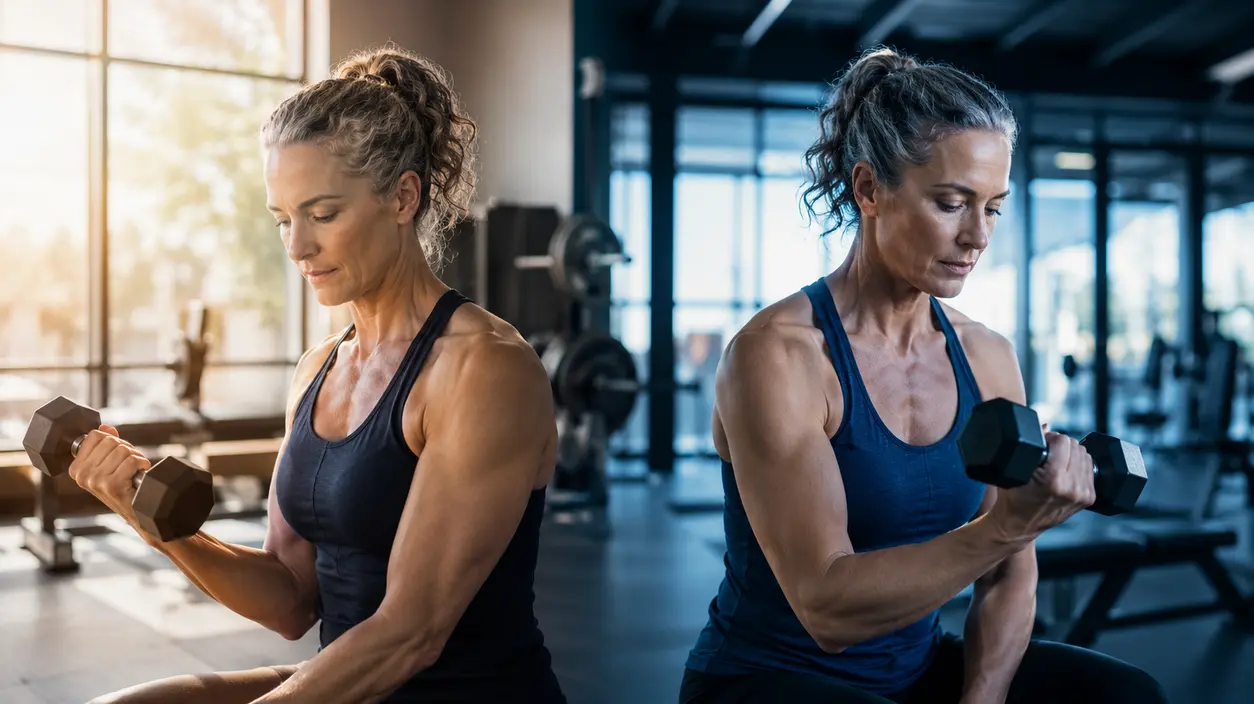
Female twin research shows that strength and power reflect both inherited and environmental influences—and that those influences are not identical across every muscle or age.
Quick answer
What does the evidence support?
Muscle strength and leg power show heritable variation in older female twin cohorts. Heritability is not a ceiling on training response.
Key takeaways
- Muscle strength and leg power show heritable variation in older female twin cohorts.
- Different muscle groups do not share identical genetic architecture.
- Environmental effects remain substantial and can emerge over time.
- Heritability is not a ceiling on training response.
Strength is not one genetic trait
In older female twins, researchers have measured grip strength, knee extension and ankle plantar flexion. Genetic modelling found different contributions across muscle groups and also identified shared environmental and individual environmental effects.
That makes a simple label such as 'born strong' scientifically weak. Muscle size, neural activation, technique, health, activity and training all contribute to performance.
Power and strength overlap—but are not identical
A later Finnish twin study found that leg extensor power and knee extensor strength shared some genetic influence, while environmental effects also explained meaningful variation. Strength and power are related outcomes, not interchangeable ones.
Three years later, new environmental effects appeared
Longitudinal follow-up of older female twins found that genetic contributions to strength were relatively stable while new non-shared environmental effects appeared at follow-up. For leg power, the relative genetic contribution changed over time.
The study could not identify one cause for those new environmental effects. They could include lifestyle change, health events or other unshared exposures.
TwinPare perspective
A useful comparison asks how strength, training volume, recovery and function change over time. It should not infer a genetic limitation from a plateau or a difference between sisters.
Source notes
The sources have been verified and editorially reviewed for this article. The limitations below show which level of conclusion the sources support.
- [women-strength-2004] Heritability of maximal isometric muscle strength in older female twins Kristina Tiainen et al.. Journal of Applied Physiology, 2004. Evidence type: Older female twin strength study Limitation: Older Finnish female twins; estimates differ by muscle group and population. Genetic regulation does not remove environmental or training effects. PubMed
- [women-power-2005] Shared genetic and environmental effects on strength and power in older female twins Kristina Tiainen et al.. Medicine & Science in Sports & Exercise, 2005. Evidence type: Older female twin study of strength and leg power Limitation: Older female twin sample. Genetic and environmental effects were both important; results are not individual forecasts. PubMed
- [women-followup-2009] Genetic and environmental effects on isometric muscle strength and leg extensor power followed up for three years among older female twins Kristina Tiainen; Sarianna Sipilä; Markku Kauppinen; Jaakko Kaprio; Taina Rantanen. Journal of Applied Physiology, 2009. Evidence type: Longitudinal older female twin study Limitation: Three-year follow-up in older female twins. New environmental effects appeared over time, but the study does not identify one specific lifestyle cause. PubMed
Editorial source review
This section shows how the article's key factual claims are linked to the source.
Phrasings that require caution
- Do not convert population heritability into a personal genetic percentage.
- Do not turn group averages into universal cycle, menopause or training rules.
- Twin designs reduce some confounding but do not by themselves prove causality.
| ID | Claim | Source support | Caution |
|---|