

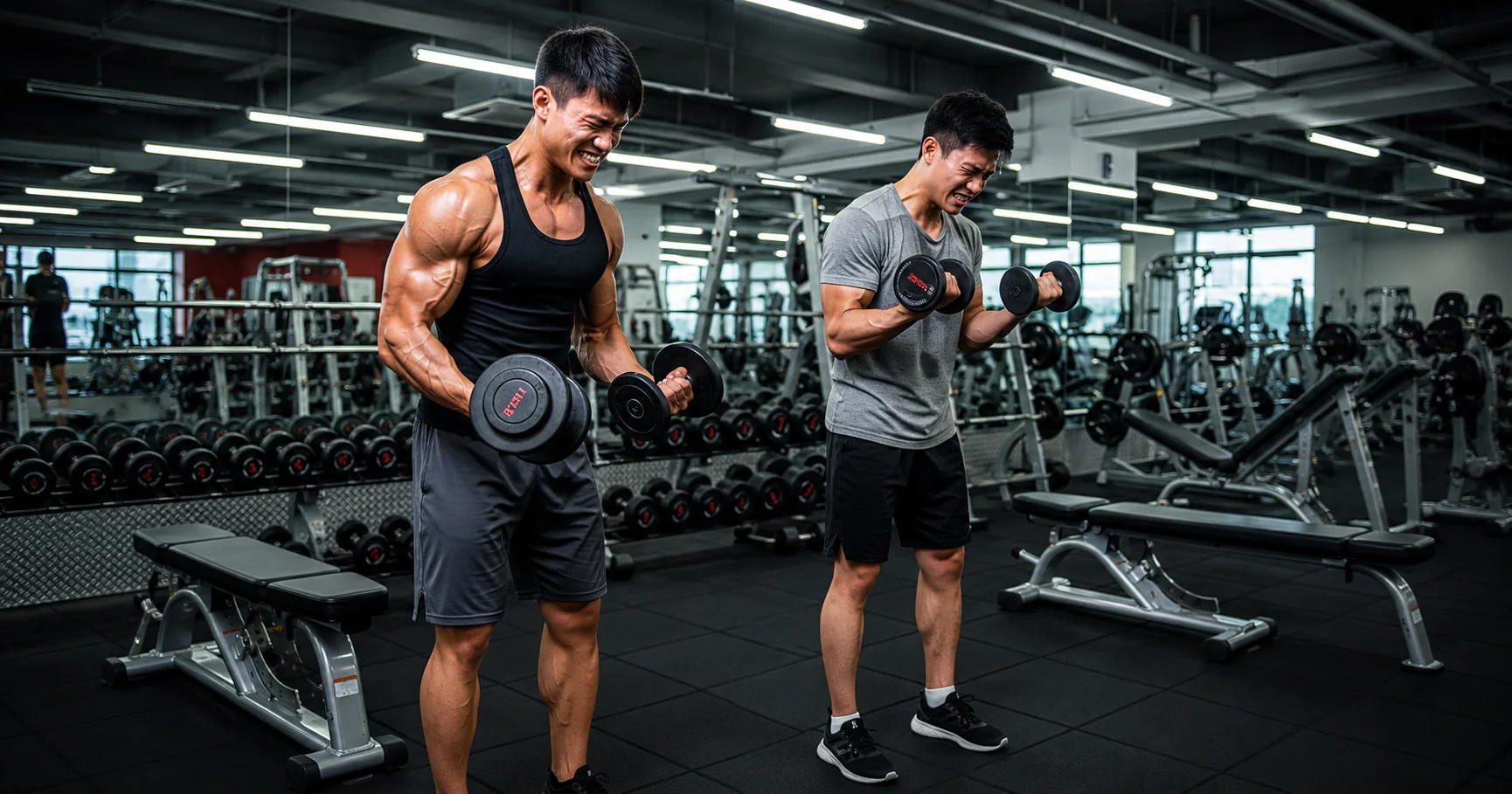
Imagine two twins who start training together. They follow the same programme, do the same exercises, and meet at the gym week after week. Yet their measured results can change in different ways.
One might improve a certain measure more clearly, while the other responds better to a different mode of training. That does not automatically mean anyone has trained right or wrong. It raises instead one of exercise science's most interesting questions: why do people respond differently to similar training?
The STRUETH project used twins to investigate exactly this variation. The results do not offer a simple verdict on genetics or a perfect programme for every person — but they do show why "the same training" does not always mean "the same result".
Quick answer
Why might identical twins following the same training programme see different results?
Even identical twins following the same training programme can see different results in strength, endurance, and body composition. Research suggests factors beyond shared genes — including sleep, lifestyle, and individual biological variation — may influence how the body adapts. No training programme produces identical outcomes for everyone.
Key takeaways
- STRUETH used a randomised crossover design in which 84 untrained twins completed both endurance and resistance training.
- The two training modes produced different group patterns and individual responses for body composition, strength, and fitness.
- Resistance training produced a larger average change in lean mass in the body composition study, but individual responses varied.
- The studies do not explain exactly why each twin responded differently and do not identify a universal best training programme.
One of exercise science's biggest mysteries
People can follow similar training programmes and still see different changes in strength, fitness, or body composition. Some of the variation may be biological, some may lie in how response is measured, and some may be influenced by what happens outside the training sessions.
Twins are especially valuable in this kind of research. They help researchers explore how similar people can respond both alike and differently, without pretending that genetics is the only factor.
What the STRUETH study examined
STRUETH stands for Studies of Twin Responses to Understand Exercise as a THerapy. In the two sources used here, 84 untrained same-sex twins participated in a randomised crossover design.
Participants completed separate periods of endurance and resistance training. This allowed researchers to compare how different training modes affected body composition, fitness, and strength within the same research project.
A controlled design makes the comparison stronger, but it does not make participants biologically identical in every detail, nor does it remove measurement uncertainty or all differences in life outside the study.
What the researchers found
In the body composition study, resistance training produced a larger average change in lean mass than endurance training. Both training modes were accompanied by varying individual changes, making it misleading to describe all participants as if they responded the same way.
The companion STRUETH study also showed that strength and aerobic fitness responses differed between training modes and individuals. People classified as low-responders on one measure after one training mode could sometimes show a clearer response after the other.
This is interesting, but the words "responder" and "low-responder" depend on which measures, thresholds, and error margins the researchers used. The results therefore do not promise that switching training modes will work for every person.
Why might results differ?
STRUETH results show variation, but they do not provide a complete answer as to why each participant responded as they did. Genetic differences may still play a role, especially since the project included both identical and fraternal twins. At the same time, training responses can be influenced by many biological and methodological factors.
In everyday life, sleep, stress, diet, recovery, prior activity history, and how consistently a programme is followed can also contribute to different starting points. These are reasonable factors to consider, but this article treats them as possible explanations — not as direct conclusions from the two STRUETH sources.
Epigenetics may be relevant in broader research on exercise and twins, but it is not used as an explanation here. That topic requires its own verified sources and belongs better in a future article.
What does this mean for twins?
If your twin gets stronger faster or improves a fitness measure more, that does not automatically mean you have failed. A single result does not tell you which programme is best for the rest of your life either.
A more useful perspective is to track your own progress over time, pay attention to how your body responds, and seek qualified guidance when health, injury, or individual needs require it. Your twin can be an inspiring training partner without needing to be your only benchmark.
The TwinPare perspective
For TwinPare, STRUETH shows why twins can help us ask better questions about exercise. Similarity makes the comparison fascinating, but difference makes it human.
The point is not that genetics is irrelevant or that every person needs a completely unique programme. The point is that training response should not be reduced to a simple verdict on willpower or discipline. Two twins can do a lot together and still need to understand their results on their own terms.
Source and limitations
The primary source supports that resistance and endurance training produced different group and individual responses for body composition, with a larger average change in lean mass after resistance training in this design.
The secondary source supports that strength and aerobic fitness responses varied between training modes and individuals. It is used only for the article's claims about strength, fitness, and response to an alternative training mode.
The sources do not prove exactly why each twin responded differently. They do not show that genetics is unimportant, that a certain programme is best for everyone, or that all low-responders on one training mode will necessarily respond better to another.
Results are also influenced by how response is defined, biological variation, and measurement uncertainty. They should therefore be read as research about patterns and variation — not as personal training promises.
Source notes
The sources have been verified and editorially reviewed for this article. The limitations below show which level of conclusion the sources support.
- [thomas-2021] Studies of Twin Responses to Understand Exercise Therapy (STRUETH): Body Composition. Hannah J. Thomas; Christopher E. Marsh; Benjamin A. Maslen; Katrina J. Scurrah; Louise H. Naylor; Daniel J. Green. Medicine & Science in Sports & Exercise, 2021. Evidence type: Randomised crossover trial in which 84 untrained twins completed periods of endurance and resistance training Limitation: Group and individual responses depend on the study's training design, measurements, and definitions. The study does not identify a universal explanation for every difference and does not prescribe a best programme for everyone. PubMed DOI
- [marsh-2020] Fitness and strength responses to distinct exercise modes in twins: Studies of Twin Responses to Understand Exercise as a THerapy (STRUETH) study. Christopher E. Marsh; Hannah J. Thomas; Louise H. Naylor; Katrina J. Scurrah; Daniel J. Green. The Journal of Physiology, 2020. Evidence type: Randomised crossover trial comparing 84 untrained twins after endurance and resistance training Limitation: Response classification is influenced by chosen measures and measurement uncertainty. Results show variation between training modes and individuals but do not prove that genetics is irrelevant or that every low-responder will respond to an alternative programme. PubMed DOI
Editorial source review
This section shows how the article's key factual claims are linked to the source.
Phrasings that require caution
- Write "in this study", "at the group level", "varied", and "may".
- Do not write that genetics is irrelevant or that the study explains exactly why each twin responds differently.
- Do not promise muscle gain, fat loss, strength increase, or improved fitness for any individual.
- Describe sleep, stress, diet, and recovery as possible everyday factors, not direct STRUETH conclusions.
- Do not use epigenetics as an explanation without additional verified sources.
| ID | Claim | Source support | Caution |
|---|---|---|---|
| C1 | Individual training responses can vary even within a controlled training programme. | 2021 , 2020 | Variation in measured responses is not the same as a complete explanation of why that variation arises. |
| C2 | STRUETH used a randomised crossover design with 84 untrained same-sex twins and separate endurance and resistance training periods. | 2021 , 2020 | Describe the study design without equating it with full control over every everyday factor. |
| C3 | Resistance training produced a larger average change in lean mass than endurance training in the body composition study. | 2021 | A group average is not a promise of muscle gain for every participant. |
| C4 | Strength and fitness responses varied between training modes and individuals, and some low-responders on one measure responded more clearly to the other training mode. | 2020 | Write "some" and tie the claim to the study's response definitions; do not use "everyone can be rescued". |
| C5 | The two STRUETH sources show variation in training responses but do not establish the exact cause of each individual's response. | 2021 , 2020 | Keep possible everyday factors separate from the studies' direct conclusions. |
| C6 | STRUETH sources can inform about patterns in training responses but cannot prescribe a universal or individually optimal programme. | 2021 , 2020 | Avoid medical or personal training advice and all guarantees. |