
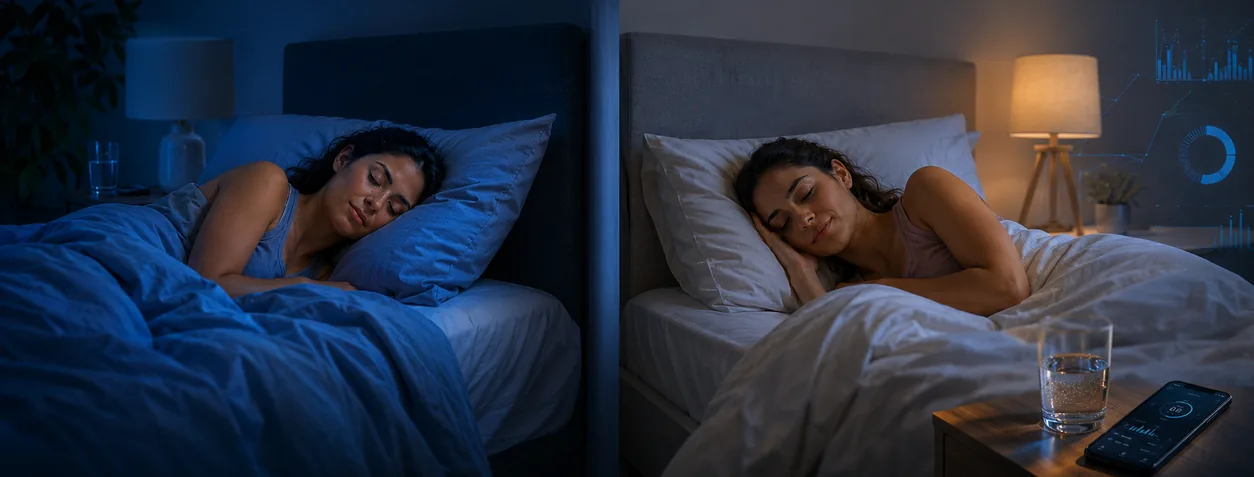
“Sleep more and you will lose weight.”
It is exactly the kind of sentence that sounds scientific, spreads beautifully on social media — and is far more confident than the evidence allows.
The relationship between sleep and body weight is genuinely interesting.
It is also complicated.
And twin research can help us ask a better question.
Quick answer
Does short sleep cause weight gain?
This twin study found an association between shorter sleep and higher BMI, but it does not prove causation or support weight-loss promises.
Key takeaways
- A twin study found an association between shorter reported sleep and higher BMI, but little evidence that shared genetic factors explained that association.
- Association is not causation.
- The article is general research information, not medical advice or an individual prediction.
1,224 twins
Researchers from the University of Washington Twin Registry studied 1,224 adult twins.
Participants reported their usual sleep duration, height and weight.
Height and weight were then used to calculate BMI.
The sample included 423 identical twin pairs, 143 fraternal twin pairs and 46 pairs whose zygosity was indeterminate.
The average age was 36.9 years, and 69% of participants were women.
The researchers found that twins reporting less than seven hours of sleep per night had a higher adjusted average BMI than those reporting between seven and 8.9 hours.
The averages were approximately:
BMI 26.0 among the shorter sleepers
versus
BMI 24.8 in the reference sleep group.
That is an association.
It is not proof that sleeping less caused the higher BMI.
Then the researchers compared twins within pairs
This is where the study becomes especially interesting.
When twins were compared with their own co-twin, the association remained.
Among sleep-duration-discordant twin pairs, shorter-sleeping twins had an average BMI of approximately:
25.8
compared with:
24.9
among twins in the 7–8.9-hour reference group.
The within-pair result helps reduce confounding from shared family background.
For identical twins, genetic background is also held especially close.
So what happened to the genetic explanation?
The result is almost the opposite of what you might expect
The researchers estimated substantial heritability for BMI and a more modest heritable contribution to sleep duration.
But their bivariate analysis found little evidence that shared genetic factors explained the association between sleep duration and BMI.
The persistence of the relationship in co-twin comparisons therefore pointed more toward environmental or non-shared influences than toward a simple shared-genetics explanation.
That is an important correction to a tempting interpretation of this study.
The interesting result is not:
“Genes explain why short sleepers weigh more.”
It is closer to:
“The short-sleep/higher-BMI association persisted even when much of the genetic and shared family background was controlled.”
But there is another trap waiting for us.
This still does not prove that short sleep causes weight gain
A co-twin comparison is powerful.
It is not magic.
Even identical twins can differ in:
work,
stress,
physical activity,
diet,
illness,
medication,
relationships,
mental health,
shift schedules
and countless other exposures.
The study was observational.
Sleep duration, height and weight were self-reported.
So even though the within-pair design reduces some major forms of confounding, it does not transform the study into a randomized sleep experiment.
That means:
“short sleep was associated with higher BMI”
is supported.
But:
“sleeping less caused the higher BMI”
goes too far.
Why might sleep and body weight be connected?
There are many plausible pathways.
Sleep can interact with appetite and eating behaviour.
Fatigue may influence movement and exercise.
Longer waking periods provide more opportunities to eat.
Stress and working hours can affect both sleep and food choices.
Metabolic and hormonal systems are also related to sleep.
And the direction does not necessarily run only one way.
Body weight and health conditions can themselves affect sleep.
That is why simple health slogans are rarely enough.
Health variables usually live inside systems.
The TwinPare perspective
This study is a perfect example of why we should avoid looking at health metrics in isolation.
Sleep does not exist in a vacuum.
Neither does body weight.
Neither does training.
Neither does activity.
TwinPare Health & Fitness is being developed around seeing multiple health trends together over time.
Not because combining several measurements magically identifies the cause.
It does not.
But it allows better questions.
From research to your own data
Imagine seeing your sleep history alongside your activity and training history.
You might ask:
Do I sleep differently during periods when activity changes?
What happens during high-training weeks?
Do changes in sleep appear alongside changes in other measurements?
Does the same pattern happen repeatedly?
The important phrase is:
alongside changes.
Not:
because of changes.
An app that detects two measurements moving together has not automatically discovered a biological mechanism.
But recurring patterns can give you something valuable:
a better question.
And good science often begins exactly there.
TwinPare Research — the takeaway
In a study of 1,224 twins, sleeping less than seven hours per night was associated with a higher BMI compared with sleeping seven to 8.9 hours.
Importantly, the association remained in within-pair analyses.
The study found little evidence that shared genetics explained the sleep-duration/BMI association, suggesting that non-shared environmental or behavioural factors may be important.
But because the study was observational, it does not prove that short sleep itself caused the difference in body weight.
Source notes
The source has been verified and editorially reviewed for this article. The limitations below show which level of conclusion the sources support.
- [watson-2010] A Twin Study of Sleep Duration and Body Mass Index. N. F. Watson; D. Buchwald; M. V. Vitiello; C. Noonan; J. Goldberg. Journal of Clinical Sleep Medicine, 2010. Evidence type: Observational twin study of 1,224 adults examining self-reported sleep duration and BMI Limitation: The study found an association, not proof of causation. BMI is the studied metric, not a direct measure of health, and the findings do not support weight-loss promises or the claim that shared genetics explains the association. PubMed
Editorial source review
This section shows how the article's key factual claims are linked to the source.
Phrasings that require caution
- Association is not causation.
- BMI is the study metric, not a complete measure of health.
- Do not promise weight loss or claim shared genetics explains the association.
| ID | Claim | Source support | Caution |
|---|---|---|---|
| S5 | A twin study found an association between shorter reported sleep and higher BMI, but little evidence that shared genetic factors explained that association. | 2010 | Association is not causation. |