
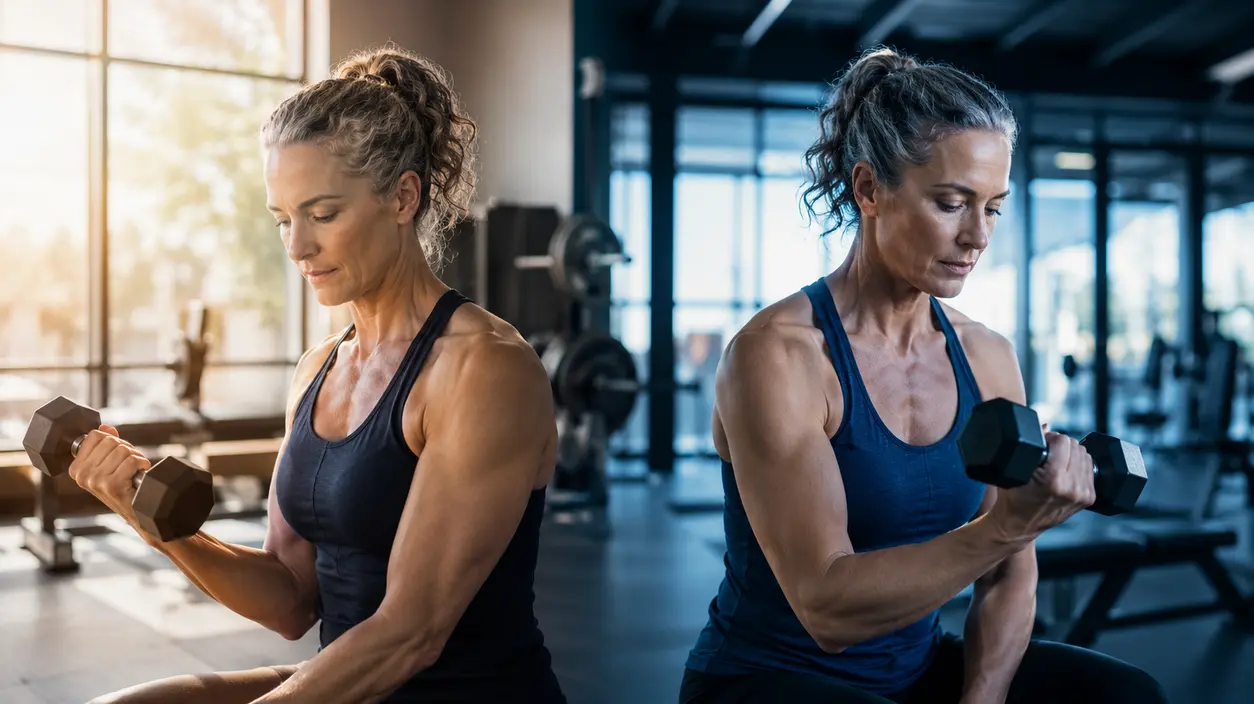
What identical twin sisters reveal about muscle, menopause and the missing exercise studies
Quick answer
What does the research show in brief?
hormone-therapy use was associated with approximately 7% higher maximal walking speed and 16% greater lower-body muscle power.
Key takeaways
- In 15 pairs of postmenopausal identical twin sisters, long-term
- In a related analysis of 13 twin pairs, electrically evoked peak
- Smaller laboratory studies from the same Finnish research programme
- These publications use overlapping subsets of one HRT-discordant twin
- Broader randomized evidence does not show a clear overall benefit of
- A strong controlled twin study of acute estrogen, progesterone,
What identical twin sisters reveal about muscle, menopause and the missing exercise studies
By TwinPare Research | Evidence review: 20 August 2026 | Estimated reading time: 9-11 minutes
Standfirst. When menopause changes the hormonal environment, muscle does not suddenly become a different organ - but the rules around strength, recovery and ageing may shift. Finnish researchers found an unusually informative natural comparison: genetically identical twin sisters in which one had used menopausal hormone therapy for years and the other had not. The results are fascinating, but they are not a prescription and they do not fill the major gap in women's exercise-hormone research.
Why the female research asks a different question
The most direct male twin study in this series measured hormone concentrations repeatedly before and after a treadmill run. The best female twin evidence uses a different natural experiment: sisters with the same DNA but different histories of menopausal hormone therapy.
That distinction matters.
The women's studies mainly ask:
Is long-term estrogen-containing hormone exposure associated with differences in muscle, mobility or tissue function between genetically identical sisters?
They do not mainly ask:
Do genetically identical women release different amounts of estrogen, progesterone, testosterone, GH or cortisol after the same workout?
Both questions are relevant to training. They are not interchangeable.
Fifteen identical twin pairs and one striking comparison
Ronkainen and colleagues recruited 15 pairs of monozygotic women aged 54-62 years from the Finnish Twin Cohort.\[1\] Within each pair, one sister had used hormone replacement therapy - now often called menopausal hormone therapy - while the other had not. Average use was approximately 6.9 years.
The researchers assessed habitual and maximal walking speed, lower-body muscle power, handgrip and knee-extension strength, thigh muscle composition and body composition.
TWIN RESEARCH SHOWS
Compared with their genetically identical sisters, hormone-therapy users had on average:
The study also reported more favorable differences in body and thigh composition in treatment-specific subgroup analyses.
Those numbers are memorable. They need equally memorable context.
The study was cross-sectional. The researchers did not randomly assign one twin to start therapy and the other to avoid it for seven years. Treatment type varied, the sample was small and the women who used therapy may have differed from their sisters in unmeasured ways before or during treatment.
The twin design controls powerfully for shared DNA, age and much of early family background. It does not control automatically for every later-life behavior, symptom, clinical reason for treatment, diet, training history or exposure.
The correct language is therefore "was associated with," not "caused."
- approximately 7% higher maximal walking speed; and
- approximately 16% greater lower-body muscle power.
Thirty-two percent higher twitch torque does not mean 32% stronger
Finni and colleagues examined 13 postmenopausal monozygotic twin pairs from the same HRT-discordant research programme.\[2\] They measured maximal voluntary plantar-flexor torque and used electrical stimulation to examine twitch characteristics before and after intermittent dynamic exercise to exhaustion.
Peak twitch torque was approximately 32% higher in the hormone-therapy users than in their non-using co-twins.
That finding can easily be turned into a misleading headline: "Estrogen made the twins 32% stronger."
The study did not show that.
Maximal voluntary contraction did not differ significantly. Activation level and twitch timing did not differ. The fatiguing exercise reduced voluntary force and twitch measures in both groups, and fatigue developed similarly.
Peak twitch torque is a specific laboratory measure of the muscle's evoked contractile response. It is not the same as how much a person can voluntarily lift, how high she can jump or how well she performs in daily life.
The interesting conclusion is narrower: long-term hormone exposure was associated with a difference in one involuntary force-generating property of the plantar-flexor muscles, even though several voluntary and fatigue outcomes were similar.
Looking inside the muscle
Related publications from the Finnish Sarcopenia, Ageing and Women and Estrogen (SAWEs) programme examined smaller subsets of the same broader twin resource.
In eleven HRT-discordant identical twin pairs, researchers found subtle but significant differences in skeletal-muscle gene-expression profiles. The affected pathways concerned cell structure, extracellular matrix, energy metabolism and nutrient use.\[3\]
In six pairs, isolated muscle-fibre experiments reported differences consistent with better contractile function and altered myonuclear organization among users.\[4\]
These studies move the question from walking speed to gene expression and individual fibres. That depth is scientifically valuable. It must not be confused with independent replication: smaller subsets, shared recruitment and related investigators mean the papers are best viewed as several lenses on one distinctive research programme.
What broader human evidence adds
HUMAN RESEARCH SHOWS
If hormone therapy reliably preserved muscle mass or made postmenopausal women stronger, randomized trials should show a reasonably consistent advantage.
A 2019 systematic review and meta-analysis included 12 studies and 4,474 postmenopausal women. It found no significant overall beneficial or detrimental association between hormone therapy and muscle mass.\[5\]
A 2020 meta-analysis of randomized controlled trials similarly concluded that hormone therapy was not associated with improved muscle strength overall.\[6\]
Individual trials and subgroups have reported positive findings, and treatment formulation, timing, dose, baseline status and training may matter. But the total evidence does not justify prescribing menopausal hormone therapy as a general muscle-building intervention.
That broader context does not make the twin findings unimportant. It tells us what they are best used for: generating and refining biological questions, not issuing a universal treatment rule.
What about younger women and androgens?
Vihma and colleagues studied 13 pairs of healthy young adult female monozygotic twins, including ten pairs with large differences in BMI.\[7\] The heavier sisters had lower serum DHEA, DHT and sex hormone-binding globulin (SHBG) than their leaner co-twins. Serum testosterone did not differ significantly.
This was not a training intervention. It does, however, demonstrate something relevant to exercise physiology: even among women with the same DNA and age, acquired differences in body fat can be associated with a different androgen environment.
It would be wrong to turn this into "exercise fixes female hormones." The study did not test that. A better synthesis is that body composition, metabolism and hormone concentrations interact, and genetically identical women can diverge.
The missing premenopausal twin study
Our source review did not identify a strong controlled twin experiment in which premenopausal women:
calendar;
That is an important gap because ordinary menstrual-cycle research is already methodologically difficult. A review of exercise studies found that only 44% of the selected papers had measured actual estrogen and progesterone concentrations; small samples and inadequate phase verification were common.\[8\]
A large systematic review and meta-analysis found that performance might be trivially reduced on average during the early follicular phase, but effects varied substantially between studies and individuals and study quality was often low.\[9\]
The practical implication is not to ignore women's experiences. It is to avoid converting uncertain group averages into rigid "cycle-syncing" rules for every woman.
- completed the same strength, HIIT or endurance protocol;
- had cycle phase verified with robust methods;
- had estrogen and progesterone measured rather than estimated from a
- were stratified by hormonal-contraceptive use;
- had testosterone, GH and cortisol measured repeatedly; and
- were followed for performance, muscle adaptation and recovery.
What this research does - and does not - show
It shows that:
mobility measures alongside different histories of hormone exposure;
walking speed and muscle power in one small twin sample;
voluntary force and fatigability do not;
associated with differences in selected androgen-related markers; and
male-only samples miss.
It does not show that:
improve athletic performance;
responses in younger women; or
treatment effect.
- genetically identical postmenopausal sisters can differ in muscle and
- long-term hormone-therapy use was associated with greater maximal
- electrically evoked muscle function can differ even when maximal
- acquired body-fat differences in younger identical twins are
- female-specific twin methods can reveal biology that mixed or
- hormone therapy caused every observed difference;
- a 32% twitch-torque difference means 32% greater real-world strength;
- menopausal hormone therapy should be started to build muscle or
- findings from postmenopausal therapy users describe menstrual-cycle
- an app or wearable can measure estrogen exposure, hormonal status or
TwinPare Perspective
The female studies reveal two kinds of invisibility.
First, identical DNA does not make later-life hormonal exposure identical. Symptoms, healthcare choices, body composition and daily routines can pull two sisters onto different physiological paths.
Second, a group average can hide important differences between outcomes. One sister can show higher evoked twitch force without higher voluntary strength. A treatment group can look better in a small twin comparison while a large meta-analysis finds no consistent overall muscle benefit.
The strongest TwinPare question is therefore not "Did estrogen win?" It is:
Which functions changed, which did not, and what else was different between the sisters over time?
That is a question built for longitudinal observation rather than a one-number verdict.
From research to self-tracking
For women who want to understand training across perimenopause, menopause or the menstrual cycle, track outcomes a consumer tool can actually observe:
Use the information to notice personal patterns and prepare better questions. Do not infer estrogen, progesterone, testosterone or treatment effectiveness from those patterns.
- completed training load, exercise type and progression;
- strength, repetitions, pace or power on repeatable sessions;
- perceived effort, energy and motivation;
- sleep duration, regularity and night-time symptoms;
- soreness and recovery over 24-48 hours;
- cycle timing and personally meaningful symptoms, where relevant;
- illness, medication changes and major life stress; and
- longer-term body-weight, waist or functional trends when appropriate.
Explore in TwinPare
TwinPare Health & Fitness can help organize training, sleep, recovery and symptom-related observations over time. Comparisons with a twin, sister, partner or friend should occur only when both people actively choose to connect and understand what is being shared.
The app is not a hormone test and does not recommend menopausal treatment. Its role is to make longitudinal patterns easier to see without turning them into a diagnosis.
TwinPare conclusion
The twin studies do not tell us that estrogen makes women stronger. They tell us something more precise and more useful.
Among small groups of genetically identical postmenopausal sisters, different histories of hormone therapy were associated with differences in maximal walking speed, muscle power, evoked twitch force, gene expression and single-fibre characteristics. Other measures were similar. Broader randomized evidence has not found a clear overall muscle-mass or strength benefit.
The research is therefore neither a miracle story nor a dead end. It is a map with several promising landmarks - and a large blank space where direct female twin training studies should be.
Same DNA can clarify the comparison. It still cannot turn observation into prescription.
Research status
The female twin evidence is small, observational and concentrated in overlapping subsets of one Finnish HRT-discordant programme. Direct controlled twin research on acute and chronic hormone responses to strength, interval and endurance training in premenopausal, perimenopausal and postmenopausal women remains a major gap.
Health information
This article provides general educational information and is not medical advice. Menopausal hormone therapy has individualized benefits, risks, contraindications, formulations and routes of administration. Decisions about starting, changing or stopping treatment should be made with qualified healthcare professionals based on symptoms, medical history and current guidance. Do not recreate research protocols or use app data as a substitute for clinical evaluation.
Did hormone therapy make the twin sisters 16% stronger?
No. The 16% result concerned lower-body muscle power in a small observational sample. Strength, power, voluntary contraction and electrically evoked twitch torque are related but different outcomes.
What does 32% higher twitch torque mean?
It describes a larger electrically evoked contractile response in a specific calf-muscle test. Maximal voluntary force did not differ, and fatigue developed similarly. It does not mean that users were 32% stronger in daily life.
Should women use hormone therapy to preserve muscle?
These twin studies cannot answer that treatment question. Broader meta-analyses have not shown a clear overall improvement in muscle mass or strength. Menopausal hormone therapy should be considered for appropriate clinical indications through an individualized discussion with healthcare professionals.
Should training be synchronized to the menstrual cycle?
Current evidence does not support one rigid cycle-based programme for every woman. Symptoms and responses can vary, and much of the research has methodological limitations. Individual tracking may be useful, but it is not a hormone measurement or universal training rule.
Can TwinPare measure estrogen or menopause status?
No. TwinPare can help users organize observable training, sleep, recovery and symptom trends. It does not measure hormones, diagnose menopause or assess hormone-therapy effectiveness.
Sources and methodology
1. Ronkainen PHA, Kovanen V, Alén M, et al. Postmenopausal hormone replacement therapy modifies skeletal muscle composition and function: a study with monozygotic twin pairs. Journal of Applied Physiology. 2009;107(1):25-33. <u>PubMed</u> | <u>DOI</u>
2. Finni T, Noorkoiv M, Pöllänen E, et al. Muscle function in monozygotic female twin pairs discordant for hormone replacement therapy. Muscle & Nerve. 2011;44(5):769-775. <u>PubMed</u> | <u>DOI</u>
3. Ronkainen PHA, Pöllänen E, Alén M, et al. Global gene expression profiles in skeletal muscle of monozygotic female twins discordant for hormone replacement therapy. Aging Cell. 2010;9(6):1098-1110. <u>PubMed</u> | <u>DOI</u>
4. Qaisar R, Renaud G, Hedström Y, et al. Hormone replacement therapy improves contractile function and myonuclear organization of single muscle fibres from postmenopausal monozygotic female twin pairs. Journal of Physiology. 2013;591(9):2333-2344. <u>Full article</u> | <u>DOI</u>
5. Javed AA, Mayhew AJ, Shea AK, Raina P. Association Between Hormone Therapy and Muscle Mass in Postmenopausal Women: A Systematic Review and Meta-analysis. JAMA Network Open. 2019;2(8):e1910154. <u>Full article</u> | <u>DOI</u>
6. Xu Y, Deng KL, Xing TF, Mei YQ, Xiao SM. Effect of hormone therapy on muscle strength in postmenopausal women: a systematic review and meta-analysis of randomized controlled trials. Menopause. 2020;27(7):827-835. <u>PubMed</u> | <u>DOI</u>
7. Vihma V, Heinonen S, Naukkarinen J, et al. Increased body fat mass and androgen metabolism - a twin study in healthy young women. Steroids. 2018;140:24-31. <u>PubMed</u> | <u>DOI</u>
8. Janse de Jonge X, Thompson B, Han A. Methodological Recommendations for Menstrual Cycle Research in Sports and Exercise. Medicine & Science in Sports & Exercise. 2019;51(12):2610-2617. <u>PubMed</u> | <u>DOI</u>
9. McNulty KL, Elliott-Sale KJ, Dolan E, et al. The Effects of Menstrual Cycle Phase on Exercise Performance in Eumenorrheic Women: A Systematic Review and Meta-Analysis. Sports Medicine. 2020;50(10):1813-1827. <u>PubMed</u> | <u>DOI</u>
10. National Institute for Health and Care Excellence. Menopause: identification and management (NG23). Updated guidance and recommendations. <u>NICE guidance</u>
Editorial method. Primary twin studies, systematic reviews and current clinical guidance were checked. Overlapping Finnish cohort publications were treated as related analyses rather than independent replications. The literature search was updated on 20 August 2026. The article is educational and not medical advice.
Source notes
The sources have been verified and editorially reviewed for this article. The limitations below show which level of conclusion the sources support.
- [source-1] <u>PubMed</u> Linked publication or source record. pubmed.ncbi.nlm.nih.gov, 2008. Evidence type: Primary or supporting source listed in the article review Limitation: Read the source together with the article’s visible limitations; the link does not support every broader interpretation. Open source
- [source-2] <u>DOI</u> Linked publication or source record. doi.org, 2008. Evidence type: Primary or supporting source listed in the article review Limitation: Read the source together with the article’s visible limitations; the link does not support every broader interpretation. Open source
- [source-3] <u>PubMed</u> Linked publication or source record. pubmed.ncbi.nlm.nih.gov, 2011. Evidence type: Primary or supporting source listed in the article review Limitation: Read the source together with the article’s visible limitations; the link does not support every broader interpretation. Open source
- [source-4] <u>DOI</u> Linked publication or source record. doi.org, 2011. Evidence type: Primary or supporting source listed in the article review Limitation: Read the source together with the article’s visible limitations; the link does not support every broader interpretation. Open source
- [source-5] <u>PubMed</u> Linked publication or source record. pubmed.ncbi.nlm.nih.gov, 2010. Evidence type: Primary or supporting source listed in the article review Limitation: Read the source together with the article’s visible limitations; the link does not support every broader interpretation. Open source
- [source-6] <u>DOI</u> Linked publication or source record. doi.org, 2010. Evidence type: Primary or supporting source listed in the article review Limitation: Read the source together with the article’s visible limitations; the link does not support every broader interpretation. Open source
- [source-7] <u>Full article</u> Linked publication or source record. pmc.ncbi.nlm.nih.gov, 2012. Evidence type: Primary or supporting source listed in the article review Limitation: Read the source together with the article’s visible limitations; the link does not support every broader interpretation. Open source
- [source-8] <u>DOI</u> Linked publication or source record. doi.org, 2012. Evidence type: Primary or supporting source listed in the article review Limitation: Read the source together with the article’s visible limitations; the link does not support every broader interpretation. Open source
- [source-9] <u>Full article</u> Linked publication or source record. pmc.ncbi.nlm.nih.gov, 2019. Evidence type: Primary or supporting source listed in the article review Limitation: Read the source together with the article’s visible limitations; the link does not support every broader interpretation. Open source
- [source-10] <u>DOI</u> Linked publication or source record. doi.org, 2019. Evidence type: Primary or supporting source listed in the article review Limitation: Read the source together with the article’s visible limitations; the link does not support every broader interpretation. Open source
- [source-11] <u>PubMed</u> Linked publication or source record. pubmed.ncbi.nlm.nih.gov, 2020. Evidence type: Primary or supporting source listed in the article review Limitation: Read the source together with the article’s visible limitations; the link does not support every broader interpretation. Open source
- [source-12] <u>DOI</u> Linked publication or source record. doi.org, 2020. Evidence type: Primary or supporting source listed in the article review Limitation: Read the source together with the article’s visible limitations; the link does not support every broader interpretation. Open source
- [source-13] <u>PubMed</u> Linked publication or source record. pubmed.ncbi.nlm.nih.gov, 2018. Evidence type: Primary or supporting source listed in the article review Limitation: Read the source together with the article’s visible limitations; the link does not support every broader interpretation. Open source
- [source-14] <u>DOI</u> Linked publication or source record. doi.org, 2018. Evidence type: Primary or supporting source listed in the article review Limitation: Read the source together with the article’s visible limitations; the link does not support every broader interpretation. Open source
- [source-15] <u>PubMed</u> Linked publication or source record. pubmed.ncbi.nlm.nih.gov, 2019. Evidence type: Primary or supporting source listed in the article review Limitation: Read the source together with the article’s visible limitations; the link does not support every broader interpretation. Open source
- [source-16] <u>DOI</u> Linked publication or source record. doi.org, 2019. Evidence type: Primary or supporting source listed in the article review Limitation: Read the source together with the article’s visible limitations; the link does not support every broader interpretation. Open source
- [source-17] <u>PubMed</u> Linked publication or source record. pubmed.ncbi.nlm.nih.gov, 2020. Evidence type: Primary or supporting source listed in the article review Limitation: Read the source together with the article’s visible limitations; the link does not support every broader interpretation. Open source
- [source-18] <u>DOI</u> Linked publication or source record. doi.org, 2020. Evidence type: Primary or supporting source listed in the article review Limitation: Read the source together with the article’s visible limitations; the link does not support every broader interpretation. Open source
Editorial source review
This section shows how the article's key factual claims are linked to the source.
Phrasings that require caution
- Association is not automatically causation.
- Twin findings describe studied groups and do not predict an individual.
- The article is general research information, not medical advice.