
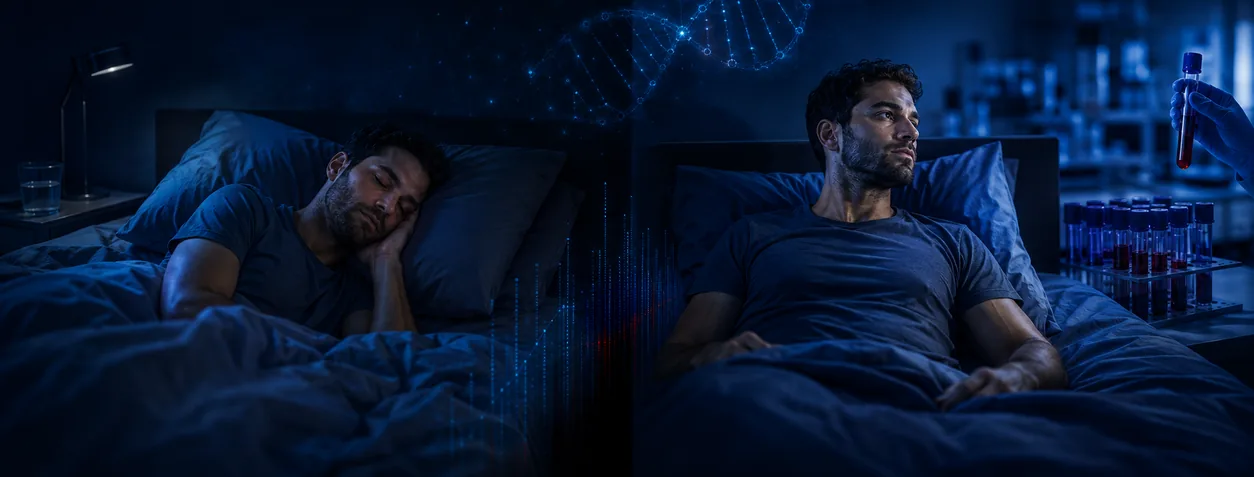
A sudden HRV drop invites a story: bad sleep, a hard workout, work stress, a brewing illness, alcohol, hormones — or something wrong with the device. The difficult part is that several of those explanations can be plausible at the same time.
That is why a personal HRV baseline is better understood as a reference pattern under reasonably comparable conditions, not a fixed biological set point. HRV can move because your physiology changed, because the measurement context changed, or because both changed together.
Quick answer
If my HRV changes, can I tell what caused it?
Usually not from HRV alone. Sleep loss, training, stress, inflammatory or infection-related states, reproductive physiology, alcohol and measurement conditions can all influence HRV. A repeated trend collected under comparable conditions is more informative than one isolated reading, but it still does not identify a single cause or diagnose a condition.
Key takeaways
- Measurement conditions matter: time of day, posture, recording duration, respiration and device method can alter HRV before biology is interpreted.
- A 2025 meta-analysis of 11 randomized studies found lower RMSSD after sleep deprivation on average, while not every HRV index changed consistently.
- Exercise training can shift longer-term HRV upward on average, while a recent hard session can change short-term recovery patterns; acute response and chronic adaptation are different questions.
- Wearable-derived HRV varies across menstrual-cycle phases and other reproductive hormone states at population level, but the pattern is not identical for every individual and should not become a readiness prescription.
- Large wearable datasets support repeated measurements for stable trend estimates, but no single study establishes one universal number of nights that defines everyone’s HRV baseline.
Baseline is a pattern, not one magic number
The word baseline can sound more precise than it is. In practice it means a personal reference built from repeated observations under reasonably comparable conditions. That reference can itself drift with age, training adaptation, reproductive life stage, illness, medication or other changes.
This is also why another person’s RMSSD is a poor target. Twin and sibling research shows a substantial inherited contribution to HRV variation, so two healthy people can begin from very different normal ranges even before lifestyle and measurement conditions are considered.
Before explaining the body, check the measurement
A 2024 methodology review grouped HRV influences into physiological, lifestyle, environmental and methodological factors. Time of day, posture, recording length and respiration are among the variables that can alter a measurement. Comparing a seated morning ECG-derived value with an overnight wearable estimate is therefore not a clean before-and-after experiment.
Technology matters too. A 2026 systematic review found useful agreement between PPG-derived pulse-rate variability and ECG-derived HRV for selected RMSSD and SDNN data, but the quantitative evidence came mainly from controlled or resting conditions. The authors cautioned against assuming interchangeability during sleep, exercise, stress or free-living use.
Sleep loss can move some HRV measures — not all of them
A 2025 systematic review and meta-analysis of 11 randomized studies with 549 participants found a significant reduction in RMSSD after sleep deprivation. LF and LF/HF increased, while changes in SDNN and HF were not statistically consistent across the pooled evidence.
That mixed pattern matters. A lower morning RMSSD after a short night can be compatible with sleep loss, but HRV alone cannot prove that sleep was the cause or quantify how “recovered” someone is.
Training can create both short-term noise and long-term adaptation
Exercise can affect HRV on different timescales. A hard session can alter the following recovery window, while repeated training over weeks or months can shift autonomic patterns as fitness changes.
A 2024 meta-analysis of 16 randomized trials involving 623 healthy adults found that exercise training improved RMSSD, SDNN and high-frequency power on average. Effects varied by factors including age, sex and exercise type, so the result is not a universal promise that every training block must raise every HRV metric.
Stress, illness and inflammation can change the signal without making it diagnostic
Research on experimentally induced psychological stress commonly reports HRV changes in directions consistent with lower parasympathetic activity. Separately, a systematic review found reduced HRV associated with inflammatory states and nosocomial infection or sepsis in clinical populations.
Neither result turns a consumer wearable into a diagnostic tool. The infection review found that predictive significance remained uncertain, and the same HRV change can arise in many different contexts. HRV can be a clue to a changing physiological state without telling you which condition is present.
Reproductive physiology can shift HRV patterns
A 2026 living systematic review of 16 wearable studies found that, on average, HRV was higher earlier and lower later in the menstrual cycle among naturally menstruating participants, with time-domain differences of roughly 3–9% across included studies. Hormonal contraceptive use and reproductive life stages were also associated with differences.
The review also found substantial variation in how studies classified cycle phase and menopausal status. These are population patterns, not a rule that every person should change training or recovery decisions according to a fixed cycle calendar.
Trend beats one night — but there is no universal baseline formula
Repeated measurements reduce the temptation to overreact to one noisy value. In a 2026 analysis of roughly two million nocturnal readings from more than 21,000 wearable users, at least five of seven nights were needed to estimate a seven-day HRV coefficient of variation with acceptable agreement in that dataset.
That result concerns the reliability of a specific weekly variability metric, not a universal rule that five nights establish everyone’s personal HRV baseline. The study also used commercial wearable data and included WHOOP-affiliated authors, so it is useful real-world evidence that should be interpreted in that context.
What a wearable can do — and what it cannot
A wearable can be valuable when it measures the same person repeatedly and makes changes easier to see over time. Consistent device, timing and context improve comparability, especially when the user also knows what happened with sleep, training, alcohol, stress, symptoms and other relevant factors.
What it cannot do from HRV alone is identify the cause of a change, diagnose infection, stress, overtraining or a mood disorder, or prescribe the correct training response. Slow breathing and alcohol during sleep also deserve their own evidence questions rather than being reduced to one baseline rule.
The twin study we would like to see
A useful future study could follow monozygotic twin pairs with the same validated measurement protocol while recording sleep, training load, alcohol exposure, perceived stress, reproductive context, symptoms and environmental factors. Repeated measurements could then separate stable between-person differences from within-person shifts while controlling some inherited variation.
That is a proposed research design, not a TwinPare study already underway. It would help answer a more precise question than “Is high HRV good?”: why does one person’s HRV move away from that person’s own pattern, and which changes are reproducible?
Source notes
The sources have been verified and editorially reviewed for this article. The limitations below show which level of conclusion the sources support.
- [damoun-hrv-methodology-2024] Heart rate variability measurement and influencing factors: Towards the standardization of methodology Narjisse Damoun; Youssra Amekran; Nora Taiek; Abdelkader Jalil El Hangouche. Global Cardiology Science & Practice, 2024. Evidence type: Methodology review of physiological, lifestyle, environmental and measurement influences on HRV Limitation: HRV interpretation is sensitive to factors such as age, sex, genetics, activity, alcohol, time of day, body position, recording duration and respiration. The review supports standardization, not one universal consumer threshold. PubMed DOI
- [zhang-sleep-deprivation-hrv-2025] Effects of sleep deprivation on heart rate variability: a systematic review and meta-analysis Suling Zhang; Xiaodan Niu; Jinke Ma; Xin Wei; Jun Zhang; Weiping Du. Frontiers in Neurology, 2025. Evidence type: Systematic review and meta-analysis of 11 randomized controlled studies with 549 participants Limitation: Sleep deprivation was associated with lower RMSSD and higher LF and LF/HF, while SDNN and HF were not consistently changed. Heterogeneity and measurement differences limit simple one-night interpretation. PubMed DOI
- [amekran-exercise-training-hrv-2024] Effects of Exercise Training on Heart Rate Variability in Healthy Adults: A Systematic Review and Meta-analysis of Randomized Controlled Trials Youssra Amekran; Abdelkader Jalil El Hangouche. Cureus, 2024. Evidence type: Systematic review and meta-analysis of 16 randomized controlled trials with 623 healthy adults Limitation: Exercise training improved several HRV indices on average, but effects differed by age, sex and exercise type. Chronic adaptation should not be confused with the acute response to a recent workout. PubMed DOI
- [grosicki-hrv-cv-wearables-2026] Heart rate variability coefficient of variation during sleep as a digital biomarker that reflects behavior and varies by age and sex Gregory J Grosicki et al.. American Journal of Physiology-Heart and Circulatory Physiology, 2026. Evidence type: Large observational wearable-data study using about two million nocturnal HRV readings from more than 21,000 users Limitation: Five of seven nights were sufficient for agreement with a full-week HRV coefficient-of-variation estimate in this dataset. This is not a universal rule for establishing an individual HRV baseline. Several authors were affiliated with WHOOP and the work received WHOOP funding. PubMed DOI
- [de-jager-wearable-hrv-female-2026] Wearable-Derived Heart Rate Variability Across the Menstrual Cycle, Hormonal Contraceptive Use, and Reproductive Life Stages in Females: A Living Systematic Review Eline de Jager; Brian Caulfield; Evgenia Angelidi; Brian MacNamee; Sinead Holden. Sports Medicine, 2026. Evidence type: Living systematic review of 16 studies using wearable-derived HRV across ovarian-hormone states Limitation: Wearable-derived HRV differed across menstrual-cycle phases, hormonal contraceptive use and reproductive life stages. Study methods varied, so these population patterns should not become a fixed readiness prescription for an individual. PubMed DOI
- [kim-stress-hrv-2018] Stress and Heart Rate Variability: A Meta-Analysis and Review of the Literature Hye-Geum Kim; Eun-Jin Cheon; Dai-Seg Bai; Young Hwan Lee; Bon-Hoon Koo. Psychiatry Investigation, 2018. Evidence type: Meta-analysis and review of human HRV responses to experimentally induced psychological stress Limitation: HRV variables often changed during stress, commonly toward lower parasympathetic activity. HRV is not a deterministic stress meter and cannot identify why one person had a particular reading. PubMed DOI
- [adam-inflammation-infection-hrv-2023] Heart rate variability as a marker and predictor of inflammation, nosocomial infection, and sepsis - A systematic review Josephine Adam; Sven Rupprecht; Erika C S Künstler; Dirk Hoyer. Autonomic Neuroscience, 2023. Evidence type: Systematic review of HRV associations and prediction studies in inflammation and infection-related states Limitation: Reduced HRV was associated with inflammatory and infection-related states, but predictive significance was uncertain. This evidence does not support using consumer HRV as an infection diagnostic. PubMed DOI
- [xu-ppg-prv-ecg-hrv-2026] Accuracy of Photoplethysmography-Derived Pulse Rate Variability Compared with Electrocardiography-Derived Heart Rate Variability: A Systematic Review and Meta-Analysis Shiwen Xu; Hao Liu; Zhengliang Liu; Peng Su; Zhuangzhuang Gu. Sensors, 2026. Evidence type: Systematic review and meta-analysis comparing PPG-derived pulse-rate variability with ECG-derived HRV Limitation: Agreement estimates were based mainly on selected resting or controlled conditions and should not be generalized to sleep, exercise, stress or free-living settings or interpreted as universal interchangeability. PubMed DOI
- [de-geus-hrv-heritability-2014] Heritability of cardiac vagal control in 24-h heart rate variability recordings: influence of ceiling effects at low heart rates E J C de Geus et al.. Psychophysiology, 2014. Evidence type: Twin and sibling ambulatory HRV study Limitation: Heritability estimates help explain between-person differences but describe population variance under specific measurement conditions, not a fixed personal genetic percentage. PubMed
Editorial source review
This section shows how the article's key factual claims are linked to the source.
Phrasings that require caution
- HRV does not diagnose recovery, psychological stress, infection, overtraining, mood disorders or other medical conditions on its own.
- A personal baseline is a statistical reference pattern, not a fixed biological set point.
- Do not infer a single cause from one unusual night or one wearable score.
- Do not treat RMSSD, SDNN, HF power and proprietary readiness or recovery scores as interchangeable.
- PPG-derived pulse-rate variability and ECG-derived HRV should not be assumed interchangeable across all conditions.
- Menstrual-cycle and reproductive-stage findings are population-level patterns and not an individualized training prescription.
- The five-of-seven-nights result applies to a specific HRV coefficient-of-variation analysis and is not a universal baseline rule.
- The proposed twin protocol is a future research idea, not evidence that TwinPare is conducting a clinical study.
| ID | Claim | Source support | Caution |
|---|