
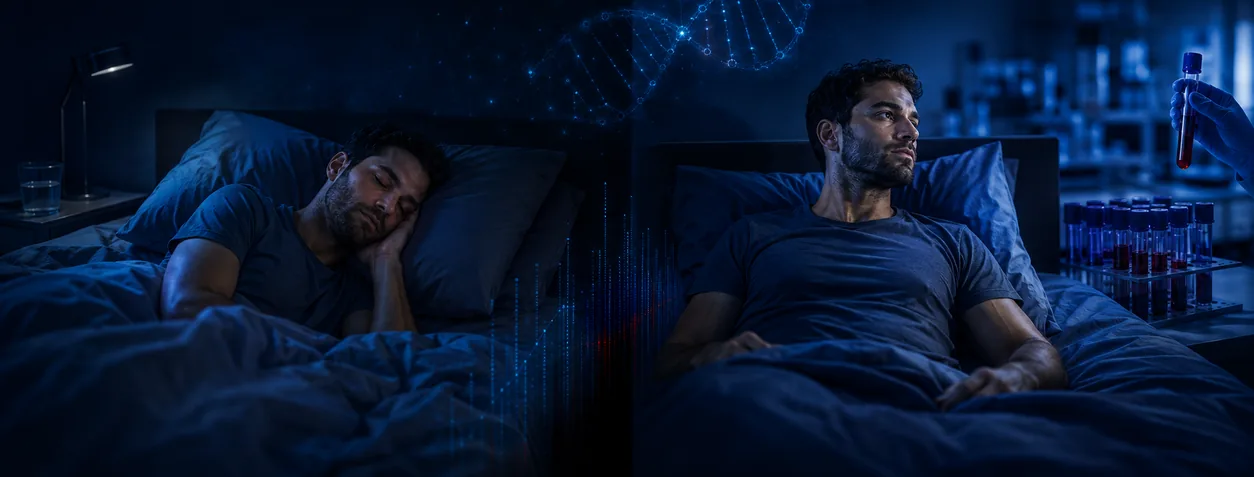
Imagine two people with almost identical DNA. One consistently sleeps about an hour longer than the other. Could scientists detect the difference all the way down at the level of gene activity?
That was the idea behind a small but unusually interesting twin study.
Researchers identified 11 healthy pairs of identical twins whose habitual sleep duration differed.
Because identical twins share essentially the same DNA sequence, researchers could compare the longer-sleeping twin with the shorter-sleeping twin while controlling for much of the genetic background that normally complicates human research.
It is one of the great strengths of the co-twin design.
Quick answer
Can habitual sleep differences show up in gene-expression patterns?
In a small identical-twin study, shorter- and longer-sleeping twins showed different blood gene-expression patterns, but the study cannot prove that one hour less sleep caused the differences.
Key takeaways
- A small identical-twin study found blood gene-expression differences between habitual shorter- and longer-sleeping co-twins.
- Do not claim the separate laboratory sleep-restriction dataset was part of the twin experiment.
- The article is general research information, not medical advice or an individual prediction.
They did not simply ask the twins how much they slept
Self-reported sleep is useful.
But memory is not a perfect measurement device.
So researchers objectively assessed habitual sleep duration using wrist actigraphy for two weeks.
The average difference in sleep duration within the twin pairs was:
64.4 minutes per 24 hours.
On the final day of monitoring, fasting blood samples were collected.
The researchers then analysed RNA from peripheral blood leukocytes — circulating white blood cells — to investigate differences in gene expression.
That distinction is essential.
The twins' DNA sequence had not somehow changed because one slept less.
Researchers were studying something different:
which genes appeared more or less active.
The molecular patterns were different
The shorter- and longer-sleeping twins showed distinct patterns of gene expression and biological pathway activity.
Researchers identified 575 differentially expressed transcripts:
369 with higher expression and 206 with lower expression in the shorter-sleeping twins.
The affected patterns included biological processes involving transcription, ribosomal activity, translation, oxidative phosphorylation, immune and inflammatory signalling, leukocyte activation and other cellular programmes.
That sounds dramatic.
Which means this is exactly where responsible science communication becomes important.
This does not mean “one hour less sleep damages your immune system”
That headline practically writes itself.
It would also go much further than the study allows.
There were only 11 twin pairs.
The natural sleep difference was observational.
Researchers measured gene expression in circulating blood cells at a single time point.
They did not show that the shorter-sleeping twins became ill more often.
They did not demonstrate that sleeping an additional 64 minutes would reverse the observed patterns.
And they did not prove that sleep duration alone caused the molecular differences.
The study is best understood as a fascinating biological signal.
Not a clinical verdict.
An important distinction: there was another sleep experiment
The researchers also wanted to compare their findings with previous experimental work.
But that second experiment was not another part of the twin study itself.
Instead, the Watson team compared their results with and reanalysed raw data from a separate previously published laboratory sleep-restriction study.
The two study designs therefore represent different questions:
one examined naturally occurring habitual sleep differences between identical twins;
the other examined experimentally imposed short-term sleep restriction in a laboratory context.
The resulting transcriptional responses were not identical.
That makes the story more complicated.
And scientifically, much more interesting.
Why twins matter so much here
Suppose we compare one random person who sleeps six hours with another who sleeps eight.
They may differ in hundreds of ways.
Genetics.
Occupation.
Stress.
Personality.
Diet.
Exercise.
Medication.
Socioeconomic circumstances.
Family history.
When researchers compare identical twins within the same pair, much of the genetic background — and part of the early family background — is held much more constant.
It does not eliminate every confounder.
The twins can still live very different lives.
But it gives researchers an unusually powerful comparison.
The TwinPare perspective
This study captures something fundamental about the TwinPare idea:
DNA is not the end of the story.
Two people with nearly identical genetic sequences can experience different environments, make different choices and develop measurable biological differences.
The same principle applies to everyone.
You cannot choose the DNA you were born with.
But your sleep, physical activity, training, stress, diet and daily routines change throughout life.
That makes health a process.
Not a snapshot.
From research to your own data
TwinPare Health & Fitness is designed around viewing health over time.
If your sleep changes, what else changes alongside it?
When training volume increases, what happens to recovery?
When activity falls, does anything else move with it?
Do similar patterns repeat across several weeks?
The app can help people see relationships in their own available data.
It cannot automatically tell them what caused those relationships.
It also does NOT measure gene expression.
Never imply that wearable data reveals the molecular changes observed in this study.
Measure. Observe. Compare. Stay curious.
And do not draw conclusions larger than the data allows.
It may sound less spectacular than a “biohack.”
But it is much closer to how good research actually works.
TwinPare Research — the takeaway
In a study of 11 identical twin pairs, an average natural difference of about one hour in habitual sleep duration was associated with different patterns of gene expression in circulating white blood cells.
The finding is biologically intriguing.
It does not prove that one extra hour of sleep causes a specific molecular or health outcome.
What it does show is that genetically highly similar people can still develop measurable biological differences alongside differences in how they live.
Source notes
The source has been verified and editorially reviewed for this article. The limitations below show which level of conclusion the sources support.
- [watson-2017] Transcriptional Signatures of Sleep Duration Discordance in Monozygotic Twins. N. F. Watson et al.. Sleep, 2017. Evidence type: Small observational co-twin study of 11 identical twin pairs with habitual sleep-duration discordance and peripheral blood gene-expression analysis Limitation: The study compared naturally different habitual sleep durations in identical twins. It does not prove that the sleep difference caused all gene-expression differences, and the separate laboratory sleep-restriction dataset was not part of the twin experiment. PubMed DOI
Editorial source review
This section shows how the article's key factual claims are linked to the source.
Phrasings that require caution
- Do not claim the separate laboratory sleep-restriction dataset was part of the twin experiment.
- Do not imply wearables measure gene expression.
- Keep the small sample and observational design visible.
| ID | Claim | Source support | Caution |
|---|---|---|---|
| S3 | A small identical-twin study found blood gene-expression differences between habitual shorter- and longer-sleeping co-twins. | 2017 | Do not claim the separate laboratory sleep-restriction dataset was part of the twin experiment. |